There are a couple of new top level domains that are opening up for registration in the next few weeks, and the announcement has attorneys wondering what, if anything, should they do?
What’s the deal?
Well first, let’s talk about what the change is. Around 2006, ICANN, the governing body for domain names on the internet started taking bids for new generic top level domains (gTLDs). Since most lucrative and/or useful domains have been taken up by domain squatters and the occasional legit business, folks welcomed the opportunity to get a branded domain name that was relevant to their business.
So, they offered companies and investors the chance to own and manage new top level domains. Some of them are innocuous (.ceo, .bike, .directory, .beer), some are scandalous (.sexy, .xxx), and some are just industry specific (.plumbing, .attorney, .lawyer).
What makes the .attorney and .lawyer gTLDs interesting, is that they are intended to act like the .gov, .edu, and .mil “sponsored” top level domains. Sponsored TLDs act as a signal of trust since not just anyone can get one of those domains. You need to meet a managing body’s criteria. In the former, you need to prove you’re an attorney (or attending an accredited law school), and in the latter, you need to be a government, educational institution or branch of military service.
I’ve always considered sites with the newer TLDs as somewhat suspect. It’s not a perfect system, but the fact that you need to pay a decent amount of money for a great .com domain is such a good filter that it tends to cloud my judgement when it comes to trusting other domains.
At least, that’s my bias. But I’m not one to assume that everyone is like me. I’m a computer nerd by trade, and as such have a fairly biased opinion when it comes to technology in general.
Enter real data…
Instead, I ran an experiment to find out for real, whether the regulated TLDs accomplish the task of inspiring trust in normal, everyday folk.
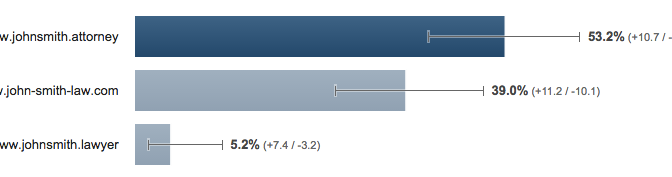
Here’s how it worked. Using Google’s awesome Consumer Surveys tool, I asked a simple question of 100 people. If you were looking to hire an attorney, based only on the domain name, who would you choose?
www.john-smith-law.com
www.johnsmith.lawyer
www.johnsmith.attorney
The idea for those three is based on the following scenario. Let’s assume you’re trying to find a domain for your solo firm. And let’s say you have a fairly common name where you can’t get the exact johnsmith.com or johnsmithlaw.com (because if you can, you should do that right now and stop reading.)
You might then consider, do I get my exact match domain with .attorney or .lawyer instead? Will that get more clients to trust me?
Well, survey says…
Overall, I was surprised by the results. I thought the .com would absolutely trounce the gTLDs and that appears to be absolutely wrong.
.attorney and .com lead the way.
Turns out, while almost noone prefered the .lawyer domain, .attorney actually appears to hold roughly equal to slightly more trust than .com when you take into account the error margins in the survey.
Here’s the preliminary result:
Younger folks prefer .com, older folks, .attorney
While that’s the general population, it’s interesting that there are fairly heavy splits when it comes to the age of the recipient. Something that might be useful to know for all your elder law folks out there.
Upper income clients still prefer .com
If your clients tend to be wealthier, or you hope to get more wealthier clients, it’s interesting to note that upper income individuals still prefer the .com.
Upper income folks seem to prefer .com dmoains ober .attorney and .lawyer
Want to analyze the data for your target clients?
If you want to comb through the data to see what your target clients might prefer, head on over to the Google survey results page and tinker to your heart’s content.
And if you think this data is bunk, or if you want more info for your own purposes, this survey is set for 100 responses and only cost $10. You can set one up yourself and target the results by geographic region and income, and you’ll have the results in a few days.
I see the data, so what should I do?
Well first, don’t panic. It might seem like there’s a great gold rush out there for these domain names, but the population that uses them is tiny (relative to other TLDs) and an even smaller fraction will actually purchase the domains. And since switching and/or deciding on a domain is a BIG deal, don’t make the decision rashly.
Should I switch to a .attorney domain?
Probably not, definitely not right away, and MOST DEFINITELY, not without some professional help.
There are a number of things to consider when considering a domain switch. You’ll need to consider the cost of replacing any marketing collateral you own like business cards, pamphlets etc.
You’ll need to perform an audit of your existing site to make sure any and all pages on your site are redirected to the new domain properly (for any site with more than 5 pages, seek professional help with this).
Should I register my existing domain with the .attorney and .lawyer TLDs?
If you have $35-$100 burning a hole in your pocket and it would make you feel better to have them just in case, go ahead and buy them. But remember, if you buy both at $35, that’s $70 every single year you own them.
But what if I want to prevent someone else from registering them?
Unless you’re a giant brand with money to spare, this is generally a false worry. First of all, as a small law firm, you’re not big enough for most squatters to care about.
Second, unless the squatter commits to building content in your niche, search engines will never find the squatter’s site anyways.
However… one case where I’d consider squatting is if your firm is hyper personalized and your name is reasonably common. For example, if you own “marystevens.com” or “marystevenslaw.com”, consider picking up “marystevens.attorney” and “marystevens.lawyer” as building a little moat around your personal brand is important when you have a common name.
I am just starting out, should I go .com or .attorney?
Based on the data, it looks like we can rule out .lawyer. And if you can get a decent .com with no dashes, go that route for sure.
But, if you found a really nice .attorney domain in a competitive niche, like say “nydefense.attorney” or “thepersonalinjury.attorney” go for it! Given that it appears that the trust is there, it can’t hurt.
But, one thing to consider is whether having the singular “attorney” or “lawyer” as a domain name will be limiting if you want to grow your firm. The domain seems to imply a single individual, and that might become an issue down the road if you suddenly have a couple of associates or additional partners.
I already registered the domains, if I don’t switch, what should I use them for?
First, redirect them to your existing site by using a CNAME or URL record with your DNS provider. I know that’s really techy, so if you need help, just email me.
Second, if you’re not changing your primary domain, do not use your new domains for things like email or other branding materials. Besides confusing your clients, it also confuses google into thinking there really are two sites and that hurts your SEO.
Should I buy up domains for multiple practice areas?
Not unless you’re creating separate sites for each and have the time to maintain them.
Just owning the domains and pointing them all at your existing site won’t really make a difference for your site traffic. Google will only recognize those domains if you actually have content on them and have links coming in using the new domains. And since it’s highly unlikely that any consumer is going to type “newyorkpersonalinjury.attorney” into their browser bar without some sort of marketing material to prompt them, you won’t get any additional direct traffic either.
But what if I’m squatting, hoping to sell the domains to other attorneys?
Well, sorry to be the one to say it, but you’re the reason we can’t have nice things (like reasonable .com domains.)
That’s it! Any more questions?
If you like this kind of no-nonsense marketing advice for solo and small firm attorneys, sign up for our marketing bootcamp where you’ll get one email every week with easy to digest marketing plans that let you get back to being a lawyer.
Just about every law firm blog post needs an image. At the very least, it’s a nice visual introduction to your post. But finding high-quality photos that are free and not likely to get you busted for copyright infringement is tough.
After all, when you pull out Google Image search, besides the dubious quality, it’s hard to tell if you have the right to use the image. And it’s likely that you don’t.
Here’s how to find a high-quality, free-to-use image for your blog post.
The long story short is that we use Flickr’s Creative Commons image search to find photos that are licensed to be used for commercial use, providing you attribute the author. Then we show you how to correctly add that attribution to your blog post.
Here’s a quick video to see how to add a great looking image to a WordPress blog post in just a few minutes, and how to add the same image to an AmazeLaw blog post in just a few seconds 🙂
Not too shabby huh? It’s fairly easy and yields great results that aren’t likely to get you sued.
See how easy AmazeLaw makes it?
That’s our whole purpose, to make marketing your firm as dead-simple as possible.
If you want to spend more time being a lawyer, and less time tinkering in HTML…
In today’s digital age, having a website that is not mobile-friendly can be a significant setback for any law firm. You might be wondering, “Why does it matter if my site looks good on a desktop?” Well, let’s dive into the reasons why a non-responsive website could be hurting your practice and what you can do about it.
Why Non-responsive Websites Are Hurting Your Law Firm
A split-screen image showing a frustrated attorney trying to navigate a non-mobile friendly website on a smartphone, with a cluttered and hard-to-read interface on one side, and a clean, user-friendly mobile site on the other side. The attorney’s expression conveys the struggle of accessing important information on a poorly designed site.
Imagine this: a potential client is searching for legal help on their smartphone. They stumble upon your website, but instead of a seamless experience, they encounter a jumbled mess of text and images that are impossible to navigate. Frustrated, they quickly leave and turn to a competitor whose site is optimized for mobile. This scenario is all too common, and it highlights a critical issue—non-responsive websites can lead to lost clients.
According to a study by Google, 61% of users are unlikely to return to a mobile site they had trouble accessing, and 40% will visit a competitor’s site instead. This statistic alone should send a shiver down the spine of any attorney who values their client base. The implications are clear: if your website isn’t mobile-friendly, you’re not just losing visitors; you’re losing potential clients.
Moreover, search engines like Google prioritize mobile-friendly sites in their rankings. This means that if your site isn’t optimized for mobile, it’s likely to appear lower in search results, making it harder for clients to find you. In a world where first impressions are often made online, a non-responsive site can tarnish your firm’s reputation before you even have a chance to connect with a client.
So how do you ensure a good user experience?
Creating a positive user experience on your website is not just about aesthetics; it’s about functionality and accessibility. Here are some practical steps you can take to ensure your site is mobile-friendly:
Responsive Design: Invest in a responsive web design that automatically adjusts to different screen sizes. This ensures that your content is easily readable and navigable, regardless of the device being used.
Fast Loading Times: Mobile users are often on the go, and they expect quick access to information. Optimize your images and streamline your code to improve loading times. A delay of just a few seconds can lead to higher bounce rates.
Simple Navigation: Make it easy for users to find what they’re looking for. Use clear menus and buttons that are easy to tap on a mobile screen. Consider the thumb zone—most users navigate with their thumbs, so place important buttons within easy reach.
Readable Text: Ensure that your text is legible without the need for zooming. Use a font size that is comfortable to read on smaller screens, and maintain good contrast between text and background.
Test Regularly: Regularly test your website on various devices and browsers to identify any issues. Tools like Google’s Mobile-Friendly Test can provide insights into how your site performs on mobile.
By implementing these strategies, you can create a user-friendly experience that not only attracts potential clients but also keeps them engaged. Remember, your website is often the first point of contact for clients seeking legal assistance, and making a positive impression is crucial.
In conclusion, as we navigate the complexities of the digital landscape, it’s essential to prioritize a mobile-friendly approach. By doing so, you’re not just enhancing your website; you’re investing in the future of your law firm. So, take a moment to reflect: is your website ready to meet the needs of today’s mobile users?
Why A Mobile Website Is Necessary
An overhead shot of a cluttered desk filled with legal documents, a laptop displaying a non-responsive website, and a smartphone showing a well-designed mobile site. The contrast between the two screens highlights the importance of mobile-friendly design for attorneys.
Have you ever tried to navigate a website on your phone, only to find yourself squinting at tiny text and struggling to click on links? Frustrating, right? In today’s fast-paced digital world, having a mobile-friendly website isn’t just a nice-to-have; it’s a necessity, especially for attorneys looking to connect with potential clients. With over 50% of web traffic coming from mobile devices, it’s clear that if your site isn’t optimized for mobile, you’re missing out on a significant audience.
Consider this: when someone is in need of legal assistance, they often turn to their smartphones for quick answers. Whether it’s a personal injury case or a family law issue, the immediacy of mobile access can make all the difference. A study by Google found that 61% of users are unlikely to return to a mobile site they had trouble accessing, and 40% will visit a competitor’s site instead. This means that a non-mobile-friendly site could not only lose you potential clients but also send them straight into the arms of your competitors.
Mobile Websites Are Easier to Use.
Imagine you’re a potential client, desperately searching for legal help. You find two law firms: one with a sleek, mobile-optimized website and another that looks like it was designed in the early 2000s. Which one are you more likely to trust? The answer is clear. A mobile-friendly website enhances user experience, making it easier for visitors to find the information they need quickly.
Mobile websites are designed with touch screens in mind, featuring larger buttons, simplified navigation, and faster loading times. According to a report by Statista, 53% of mobile users will abandon a site that takes longer than three seconds to load. This means that if your site is slow or cumbersome, you risk losing potential clients before they even have a chance to learn about your services.
Moreover, a well-designed mobile site can guide users through the process of contacting you or scheduling a consultation. For instance, incorporating click-to-call buttons allows users to reach you with a single tap, removing barriers and making it easier for them to take action. This seamless experience can significantly increase your conversion rates.
Mobile Friendly Websites Rank Better.
Did you know that Google prioritizes mobile-friendly websites in its search rankings? This means that if your site isn’t optimized for mobile, it’s likely to be buried beneath your competitors in search results. In fact, Google’s mobile-first indexing approach means that the mobile version of your site is considered the primary version, impacting your visibility online.
According to a study by Search Engine Journal, websites that are mobile-friendly see a up to 50% increase in organic traffic. This is crucial for attorneys who rely on search engine visibility to attract new clients. If your site isn’t mobile-friendly, you’re not only risking user experience but also your search engine rankings.
Furthermore, Google’s algorithm takes into account factors like page speed, mobile usability, and responsive design. By ensuring your website meets these criteria, you’re not just improving user experience; you’re also enhancing your SEO strategy. This dual benefit can lead to increased traffic, higher engagement, and ultimately, more clients.
In conclusion, as we navigate this digital landscape, it’s essential to recognize that a mobile-friendly website is no longer optional for attorneys. It’s a vital tool for connecting with clients, enhancing user experience, and improving search engine rankings. So, if you haven’t yet optimized your site for mobile, now is the time to take action. Your future clients are waiting, and they’re searching for you on their phones.
A Primer on Mobile Websites for Attorneys
A creative infographic-style image that visually represents the statistics of mobile usage among clients, with icons of smartphones, tablets, and laptops. The background features a blurred image of an attorney’s office, emphasizing the need for mobile-friendly websites in the legal field.
In today’s fast-paced digital world, where information is just a tap away, having a mobile-friendly website is no longer a luxury—it’s a necessity, especially for attorneys. Imagine a potential client searching for legal help on their smartphone, only to be met with a clunky, hard-to-navigate website. Frustrating, right? This scenario is all too common, and it can cost you valuable clients. Let’s dive into why mobile websites are crucial for attorneys and how they differ from traditional desktop sites.
The difference between a mobile website and a traditional desktop website:
At first glance, you might think a website is just a website, but there’s a world of difference between mobile and desktop versions. A traditional desktop website is designed for larger screens, often featuring intricate layouts and detailed graphics that can be overwhelming on a mobile device. In contrast, a mobile website is streamlined and optimized for smaller screens, ensuring that users can easily navigate and find the information they need.
For instance, consider the layout: a desktop site might have multiple columns of text, while a mobile site will typically use a single-column format that’s easier to scroll through. Additionally, mobile sites often utilize larger buttons and simplified menus, making it easier for users to tap and interact without the frustration of pinching and zooming.
According to a study by Google, 61% of users are unlikely to return to a mobile site they had trouble accessing, and 40% will visit a competitor’s site instead. This statistic underscores the importance of having a mobile-friendly site that caters to the needs of your clients on the go.
Mobile sites should offer the user the following key features:
Responsive Design: This means your website automatically adjusts to fit the screen size of the device being used. A responsive design not only enhances user experience but also improves your site’s SEO ranking.
Fast Loading Times: Mobile users are often on the move and expect quick access to information. A delay of just a few seconds can lead to a significant drop in user engagement. Aim for a loading time of under three seconds.
Easy Navigation: Simplified menus and clear calls to action are essential. Users should be able to find contact information, services, and other critical details without excessive scrolling or searching.
Contact Options: Incorporate features like click-to-call buttons, which allow users to call your office directly from the website. This convenience can significantly increase the likelihood of potential clients reaching out.
Readable Text: Ensure that your text is legible without zooming. Use larger fonts and adequate spacing to make reading easy on the eyes.
Incorporating these features not only enhances user experience but also builds trust with potential clients. When your website is easy to navigate and visually appealing, it reflects your professionalism and attention to detail—qualities that are essential in the legal field.
As we move forward in this digital age, remember that your website is often the first impression potential clients will have of your practice. By ensuring it is mobile-friendly, you’re not just keeping up with the times; you’re positioning yourself as a forward-thinking attorney ready to meet the needs of your clients wherever they are.
Should my entire site be mobile-friendly?
Have you ever tried to navigate a website on your phone, only to find yourself squinting at tiny text and awkwardly zooming in? It’s frustrating, isn’t it? Now, imagine your potential clients experiencing that same annoyance when they visit your law firm’s website. In today’s digital age, where over 50% of web traffic comes from mobile devices, the question isn’t just whether your site should be mobile-friendly; it’s a matter of survival in a competitive market.
Consider this: a study by Google found that 61% of users are unlikely to return to a mobile site they had trouble accessing. If your site isn’t optimized for mobile, you risk losing not just visitors, but potential clients who might have otherwise reached out for your legal services. It’s not just about aesthetics; it’s about functionality and user experience.
Moreover, search engines like Google prioritize mobile-friendly sites in their rankings. This means that if your site isn’t optimized, you could be buried beneath competitors who have taken the necessary steps to ensure a seamless mobile experience. So, yes, your entire site should be mobile-friendly—not just for the sake of appearances, but to enhance accessibility, improve user experience, and ultimately, grow your practice.
How to Make a Mobile-Friendly Website for Lawyers
A close-up shot of an attorney’s hands typing on a laptop, with a visible error message on the screen indicating a non-mobile friendly site. The focus is on the hands and the screen, capturing the frustration and urgency of the situation, while the background subtly includes legal books and documents.
Creating a mobile-friendly website might sound daunting, but it doesn’t have to be. Let’s break it down into manageable steps that you can implement to ensure your law firm’s website is accessible and user-friendly on all devices.
Responsive Design: This is the cornerstone of a mobile-friendly site. A responsive design automatically adjusts the layout based on the screen size. Think of it as a flexible suit that fits perfectly, whether you’re in a boardroom or at a casual coffee shop.
Optimize Images: Large images can slow down your site, especially on mobile. Use compressed images that maintain quality but load quickly. Tools like TinyPNG can help with this.
Simple Navigation: Mobile users appreciate simplicity. Ensure your navigation is intuitive, with clear labels and easy-to-click buttons. A hamburger menu can be a great way to save space while keeping options accessible.
Readable Text: Avoid tiny fonts that require zooming. Aim for a minimum font size of 16 pixels to ensure readability without straining the eyes.
Test Your Site: Regularly check how your site performs on various devices. Tools like Google’s Mobile-Friendly Test can provide insights and suggestions for improvement.
By following these steps, you can create a mobile-friendly website that not only looks good but also functions seamlessly, making it easier for potential clients to connect with you.
Why Make Your Law Firm Website Mobile-Responsive?
Have you ever thought about the last time you searched for a service on your phone? Perhaps you were looking for a nearby restaurant or a local service provider. Now, think about how you felt when you found a site that was easy to navigate versus one that was a hassle. This experience is crucial for your law firm’s online presence.
Making your website mobile-responsive isn’t just a trend; it’s a necessity. Here are a few compelling reasons to consider:
Enhanced User Experience: A mobile-responsive site provides a better user experience, which can lead to longer visit durations and lower bounce rates. When users find what they need quickly and easily, they’re more likely to reach out.
Increased Visibility: As mentioned earlier, Google favors mobile-friendly sites in search rankings. This means that a responsive design can help you appear higher in search results, making it easier for potential clients to find you.
Competitive Advantage: Many law firms still have outdated websites that aren’t mobile-friendly. By investing in a responsive design, you can set yourself apart from the competition and position your firm as modern and client-focused.
Future-Proofing: As technology continues to evolve, more users will rely on mobile devices for their online activities. A mobile-responsive site ensures that you’re prepared for the future, no matter how the digital landscape changes.
In conclusion, making your law firm’s website mobile-responsive is not just about keeping up with trends; it’s about meeting the needs of your clients and ensuring your practice thrives in a digital-first world. So, let’s embrace this change together and create a welcoming online space for those who need your expertise the most.
Mobile Website Optimization for Lawyers: 11 Key Elements
In today’s fast-paced digital world, having a mobile-friendly website is no longer just a luxury; it’s a necessity, especially for attorneys looking to connect with potential clients. Did you know that over 50% of web traffic now comes from mobile devices? This statistic alone should make you pause and consider how your website performs on smartphones and tablets. Let’s explore the essential elements of mobile website optimization that can help you stand out in a crowded legal market.
1. Responsive Web Design
Imagine this: a potential client is searching for legal help on their phone, and they stumble upon your website. They’re excited to learn more, but as they scroll, they find themselves pinching and zooming just to read your content. Frustrating, right? This is where responsive web design comes into play. A responsive website automatically adjusts its layout and content based on the screen size, ensuring a seamless experience for users, regardless of the device they’re using.
— Mobile-Friendly vs. Mobile-Responsive: Optimizing Your Lawyer Website for Mobile
It’s important to understand the difference between a mobile-friendly site and a mobile-responsive one. A mobile-friendly site may simply have a separate version for mobile users, which can lead to inconsistencies in branding and user experience. On the other hand, a mobile-responsive site adapts fluidly to any screen size, providing a cohesive experience across all devices.
According to a study by Google, 61% of users are unlikely to return to a mobile site they had trouble accessing, and 40% will visit a competitor’s site instead. This highlights the importance of not just having a mobile-friendly site, but a truly responsive one. Think of it as creating a welcoming environment for your clients—one that feels familiar and easy to navigate, no matter how they access it.
To achieve this, consider the following:
Flexible Grids: Use a grid system that allows your content to resize and rearrange based on the screen size.
Media Queries: Implement CSS media queries to apply different styles for different devices, ensuring optimal readability and usability.
Fluid Images: Ensure images scale appropriately to fit the screen, preventing any awkward cropping or distortion.
By focusing on responsive web design, you’re not just enhancing user experience; you’re also improving your site’s SEO. Google prioritizes mobile-friendly sites in search results, meaning that a well-optimized site can lead to increased visibility and, ultimately, more clients. So, as you think about your website, ask yourself: Is it truly welcoming to mobile users? If not, it might be time for a redesign that embraces the responsive approach.
2. Mobile-Friendly Layout
Imagine this: you’re sitting in a coffee shop, scrolling through your phone, looking for a local attorney to help with a pressing legal issue. You find a website that looks great on your desktop but is a jumbled mess on your phone. Frustrating, right? This scenario is all too common, and it highlights the critical need for a mobile-friendly layout in today’s digital landscape.
According to a study by Statista, over 54% of global website traffic comes from mobile devices. If your site isn’t optimized for mobile, you’re not just losing potential clients; you’re also sending a message that you’re out of touch with modern technology. A mobile-friendly layout ensures that your website is responsive, meaning it adjusts seamlessly to different screen sizes. This not only enhances user experience but also boosts your search engine rankings, as Google prioritizes mobile-friendly sites.
For instance, consider the law firm of Smith & Associates. They revamped their website to feature a mobile-first design, which included larger buttons, simplified text, and a clean layout. As a result, they saw a 30% increase in mobile inquiries within just a few months. This transformation not only made it easier for clients to navigate but also reflected their commitment to accessibility and modernity.
3. Optimized Navigation Menu
Have you ever visited a website where you felt like you were on a treasure hunt, trying to find the information you needed? A confusing navigation menu can lead to frustration and, ultimately, lost clients. An optimized navigation menu is essential for guiding visitors through your site effortlessly.
When designing your navigation, think about the most common questions your clients might have. What services do you offer? How can they contact you? A well-structured menu should include clear categories and subcategories, allowing users to find what they need in just a few clicks. For example, a law firm might categorize their services into sections like “Personal Injury,” “Family Law,” and “Criminal Defense.”
Moreover, consider the placement of your navigation menu. Research shows that users expect to find the menu at the top of the page or on the left side. A study by Nielsen Norman Group found that users typically look for navigation in these areas first. By adhering to these conventions, you can create a more intuitive experience for your visitors.
Take the example of Johnson Law Group, which implemented a sticky navigation menu that remains visible as users scroll down the page. This simple change led to a 25% increase in page views and a significant drop in bounce rates, as clients could easily access different sections without having to scroll back up.
4. Streamlined Forms
Picture this: you’re ready to reach out to an attorney, but when you click on the contact form, you’re met with a lengthy, complicated questionnaire that feels more like a chore than a means of communication. This is where streamlined forms come into play. They are crucial for converting visitors into clients.
Research indicates that forms with fewer fields can increase conversion rates significantly. A study by HubSpot found that reducing the number of fields from 11 to 4 can lead to a 120% increase in submissions. So, what does this mean for your law firm? It means simplifying your forms to only ask for essential information, such as name, email, phone number, and a brief description of the legal issue.
Additionally, consider using auto-fill options and clear labels to guide users through the process. For example, instead of asking for “Date of Incident,” you might simply ask for “When did this happen?” This small change can make a big difference in how approachable your form feels.
Take a cue from Greenfield Legal, which revamped their contact form by reducing it to just three fields and adding a friendly message encouraging users to reach out. This change resulted in a 50% increase in form submissions within weeks, demonstrating the power of a user-friendly approach.
5. Easy-to-Read Typography
Imagine you’re scrolling through a website on your phone, trying to find information about a legal service. You squint at the tiny text, struggling to decipher the words. Frustrating, right? Typography plays a crucial role in how users interact with your site, especially on mobile devices. When it comes to legal websites, where clarity and professionalism are paramount, easy-to-read typography can make all the difference.
According to a study by the Nielsen Norman Group, users often abandon websites that are difficult to read. This is particularly true for mobile users, who may be on the go and looking for quick answers. So, what does “easy-to-read” typography look like? Here are some key elements:
Font Size: Use a minimum font size of 16 pixels for body text. This ensures that your content is legible without users needing to zoom in.
Font Style: Choose sans-serif fonts like Arial or Helvetica for body text. These fonts are generally easier to read on screens compared to serif fonts.
Line Spacing: Adequate line spacing (1.5 times the font size) can enhance readability, making it easier for users to follow along.
Contrast: Ensure there’s a strong contrast between the text and background colors. Dark text on a light background is often the most readable.
By prioritizing typography, you not only enhance user experience but also convey a sense of professionalism and trustworthiness—qualities that are essential in the legal field.
6. Effective Call-to-Actions
Have you ever visited a website and felt lost, unsure of what to do next? This is where effective call-to-actions (CTAs) come into play. For attorneys, CTAs are vital for guiding potential clients through the decision-making process. They should be clear, compelling, and strategically placed throughout your site.
Consider this: a well-placed CTA can significantly increase conversion rates. According to HubSpot, personalized CTAs convert 202% better than generic ones. Here are some tips for crafting effective CTAs:
Be Direct: Use action-oriented language like “Schedule a Free Consultation” or “Get Your Case Evaluation Today.” This tells users exactly what to do.
Make it Stand Out: Use contrasting colors and larger buttons to draw attention to your CTAs. They should be easily noticeable without being overwhelming.
Create Urgency: Phrases like “Limited Time Offer” or “Contact Us Today” can encourage users to act quickly.
Position Strategically: Place CTAs at the top of the page, within the content, and at the end of articles. This ensures they’re visible at various points during the user’s journey.
Remember, the goal of your website is not just to inform but to convert visitors into clients. Effective CTAs are your roadmap to achieving that goal.
7. Optimized Images
We live in a visual world, and images can speak volumes about your law firm. However, if your website is filled with large, unoptimized images, it can lead to slow loading times, which is a major turn-off for mobile users. In fact, Google reports that 53% of mobile users abandon sites that take longer than three seconds to load. So, how can you ensure your images enhance rather than hinder your site’s performance?
Here are some best practices for optimizing images:
File Size: Compress images to reduce their file size without sacrificing quality. Tools like TinyPNG or ImageOptim can help with this.
Responsive Design: Use responsive images that adjust to different screen sizes. This ensures that your images look great on both mobile and desktop devices.
Descriptive Alt Text: Always include alt text for your images. This not only improves accessibility but also helps with SEO, making it easier for potential clients to find you online.
Relevance: Choose images that are relevant to your content. High-quality, professional images can enhance your credibility and make your site more engaging.
By optimizing your images, you not only improve loading times but also create a more visually appealing and professional website. This can significantly impact how potential clients perceive your firm and their likelihood of reaching out for your services.
8. Minimal Pop-Ups and Interstitials
Imagine you’re browsing a website, eager to find information, and suddenly, a large pop-up obscures your view, demanding your email address before you can proceed. Frustrating, right? For attorneys, creating a user-friendly experience is crucial, especially when potential clients are seeking legal help. Minimizing pop-ups and interstitials is not just a matter of aesthetics; it’s about respecting your visitors’ time and attention.
According to a study by Google, sites that use intrusive interstitials can see a significant drop in user engagement. In fact, 70% of users reported that they dislike pop-ups that interrupt their browsing experience. This is particularly relevant for law firms, where trust and professionalism are paramount. You want your visitors to feel welcomed, not bombarded.
Instead of using aggressive pop-ups, consider alternatives that are less intrusive. For instance, a subtle banner at the top of the page can effectively communicate your message without disrupting the user experience. This approach not only enhances usability but also aligns with best practices for SEO, as search engines favor sites that prioritize user experience.
Incorporating minimal pop-ups can also lead to higher conversion rates. A law firm that implemented a simple, non-intrusive contact form saw a 30% increase in inquiries. This shows that when you respect your visitors’ experience, they are more likely to engage with your content and reach out for assistance.
9. Accelerated Load Times
Have you ever clicked on a website only to be met with a spinning wheel of doom? It’s a common frustration, and for attorneys, slow load times can mean lost clients. In today’s fast-paced digital world, users expect websites to load in under three seconds. If your site takes longer, you risk losing potential clients who may turn to competitors with faster, more efficient sites.
Research from Google indicates that a one-second delay in load time can lead to a 7% reduction in conversions. For a law firm, this could translate to a significant loss in potential cases. So, how can you ensure your site loads quickly? Here are a few strategies:
Optimize Images: Large images can slow down your site. Use tools to compress images without sacrificing quality.
Minimize HTTP Requests: Reduce the number of elements on your page to decrease load times.
Leverage Browser Caching: This allows returning visitors to load your site faster by storing certain elements in their browser.
By focusing on load times, you not only improve user experience but also enhance your site’s SEO ranking. A law firm that prioritized site speed saw a 50% increase in traffic and a notable uptick in client inquiries. It’s a win-win situation: faster load times lead to happier visitors and more business.
10. Using HTML5 Code
As technology evolves, so do the tools we use to create websites. HTML5 is a powerful coding language that offers a range of benefits for attorneys looking to enhance their online presence. But what exactly makes HTML5 a game-changer?
First, HTML5 allows for better multimedia integration. This means you can easily embed videos, audio, and interactive elements without relying on third-party plugins, which can slow down your site. For example, imagine a law firm showcasing client testimonials through video directly on their homepage. This not only engages visitors but also builds trust, as potential clients can see real stories from satisfied clients.
Moreover, HTML5 is designed to be mobile-friendly. With more people accessing websites via smartphones, using HTML5 ensures that your site is responsive and looks great on any device. A study by Statista found that over 50% of web traffic now comes from mobile devices. If your site isn’t optimized for mobile, you’re missing out on a significant audience.
Additionally, HTML5 supports semantic elements, which improve accessibility and SEO. By using proper tags, search engines can better understand your content, leading to improved rankings. A law firm that revamped its site using HTML5 saw a 40% increase in organic search traffic within months.
Incorporating HTML5 into your website isn’t just a technical upgrade; it’s a step towards creating a more engaging, accessible, and user-friendly experience for your visitors. As you consider your site’s future, think about how these advancements can help you connect with clients in a meaningful way.
11. Mobile-Responsive Test Tool for Lawyers
In today’s digital landscape, where smartphones have become an extension of ourselves, ensuring your law firm’s website is mobile-responsive is not just a luxury; it’s a necessity. Have you ever tried to navigate a website on your phone only to find yourself squinting at tiny text or struggling to click on buttons that are too close together? Frustrating, right? This experience can drive potential clients away, which is why using a mobile-responsive test tool is crucial for attorneys.
Mobile-responsive test tools allow you to see how your website performs on various devices. They analyze your site’s layout, loading speed, and usability on mobile screens. One popular tool is Google’s Mobile-Friendly Test, which provides instant feedback on whether your site meets mobile usability standards. Simply enter your URL, and within seconds, you’ll receive a report detailing any issues and suggestions for improvement.
Another excellent option is BrowserStack, which lets you test your site across different devices and browsers. This can be particularly useful for attorneys who want to ensure their site looks great on both iOS and Android devices. By using these tools, you can identify and rectify issues before they impact your potential clients’ experience.
Moreover, a study by Statista revealed that over 54% of global website traffic comes from mobile devices. This statistic underscores the importance of having a mobile-friendly site. If your website isn’t optimized for mobile, you risk losing more than just visitors; you could be losing valuable clients who might have otherwise reached out for your legal services.
— Best Mobile Friendliness Tests for Law Firms
When it comes to testing your law firm’s website for mobile friendliness, not all tools are created equal. Here are some of the best options tailored for legal professionals:
Google Mobile-Friendly Test: This tool is straightforward and provides a clear pass/fail result, along with actionable insights.
GTmetrix: While primarily a speed test, GTmetrix also offers insights into how your site performs on mobile devices, including loading times and recommendations for improvement.
MobileTest.me: This tool allows you to view your website as it would appear on various mobile devices, giving you a real-time look at user experience.
Responsive Design Checker: This tool helps you see how your site looks on different screen sizes, ensuring that your content is accessible and visually appealing.
By regularly testing your website with these tools, you can stay ahead of the curve and ensure that your site meets the needs of today’s mobile users. Remember, a seamless mobile experience can be the difference between a potential client reaching out or moving on to a competitor.
6 Must-Have Features for a Successful Attorney Website
Imagine you’re a potential client searching for legal help. You land on a law firm’s website, and what do you see? A cluttered layout, outdated information, and no clear way to contact the firm. You’d likely click away, right? To avoid this scenario, let’s explore the six must-have features that can transform your attorney website into a powerful tool for attracting and retaining clients.
1. Clear Contact Information
Your contact information should be front and center. Make it easy for potential clients to reach you by including a dedicated contact page with your phone number, email, and office address. Consider adding a contact form for convenience. A study by HubSpot found that websites with visible contact information generate 47% more leads.
2. User-Friendly Navigation
Think about how you navigate websites. You want to find information quickly without feeling lost. A well-structured menu with clear categories can guide visitors through your site effortlessly. Use descriptive labels for your pages, such as “Practice Areas” and “Client Testimonials,” to help users find what they need.
3. Compelling Content
Content is king, especially in the legal field. Your website should feature informative articles, blog posts, and FAQs that address common legal questions. This not only positions you as an expert but also helps with search engine optimization (SEO). According to Content Marketing Institute, 70% of consumers prefer getting to know a company via articles rather than ads.
4. Client Testimonials
Nothing builds trust like hearing from satisfied clients. Incorporate testimonials and case studies on your website to showcase your successes. Real stories resonate with potential clients and can significantly influence their decision to choose your services.
5. Mobile Optimization
As we discussed earlier, mobile optimization is crucial. Ensure your website is responsive and looks great on all devices. A mobile-friendly site not only improves user experience but also boosts your search engine rankings.
6. Strong Call-to-Action (CTA)
Every page on your website should have a clear call-to-action. Whether it’s “Schedule a Consultation” or “Contact Us Today,” a strong CTA guides visitors on what to do next. Make it easy for them to take that step toward engaging your services.
By incorporating these six features, you can create a website that not only attracts visitors but also converts them into clients. Remember, your website is often the first impression potential clients have of your firm, so make it count!
Mobile-Friendly and Responsive Design
Have you ever tried to access a website on your phone, only to find yourself squinting at tiny text and struggling to click on links? It’s frustrating, isn’t it? For attorneys, having a mobile-friendly and responsive design is not just a luxury; it’s a necessity. With over 50% of web traffic now coming from mobile devices, your website must adapt seamlessly to different screen sizes. If it doesn’t, you risk losing potential clients who may simply click away in search of a more user-friendly experience.
Responsive design means that your website will automatically adjust its layout based on the device being used. This isn’t just about aesthetics; it’s about functionality. For instance, a study by Google found that 61% of users are unlikely to return to a mobile site they had trouble accessing. Imagine a potential client looking for legal help, only to be met with a clunky, hard-to-navigate site. They might not give you a second chance.
Consider the example of a small law firm that revamped its website to be mobile-friendly. After implementing a responsive design, they saw a 30% increase in mobile traffic and a significant boost in client inquiries. This change not only improved user experience but also enhanced their search engine rankings, as Google prioritizes mobile-friendly sites in its results. So, if you haven’t yet optimized your site for mobile, now is the time to act!
Attorney Profiles and Practice Area Pages
When was the last time you took a good look at your attorney profile or practice area page? These sections are often the first impression potential clients have of you, and they can make or break their decision to reach out. Think of your profile as your digital handshake—warm, inviting, and informative. It should convey not just your qualifications, but also your personality and approach to law.
According to a survey by the American Bar Association, 75% of clients prefer to hire an attorney who has a well-detailed online profile. This means that your profile should include not only your education and experience but also your areas of expertise, notable cases, and even personal anecdotes that showcase your passion for the law. For example, if you specialize in family law, sharing a brief story about why you chose this path can create a connection with potential clients who may be going through similar situations.
Practice area pages are equally important. They should clearly outline the services you offer, the types of cases you handle, and what clients can expect when working with you. Use simple language and avoid legal jargon that might confuse someone who is already feeling overwhelmed. A well-structured practice area page can significantly improve your site’s SEO, making it easier for clients to find you when they search for legal help online.
Intuitive Navigation
Have you ever visited a website that felt like a maze? You click on one link, only to find yourself lost in a sea of information. This experience can be particularly detrimental for law firms, where potential clients are often seeking immediate assistance. Intuitive navigation is key to ensuring that visitors can easily find the information they need without frustration.
Imagine a potential client looking for information on personal injury law. If they land on your site and can’t quickly locate your practice area page or contact information, they may leave and never return. A study by the Nielsen Norman Group found that 94% of users cite poor navigation as a reason for abandoning a website. To avoid this pitfall, consider implementing a clear menu structure with well-labeled categories and subcategories.
Additionally, incorporating a search function can greatly enhance user experience. This allows visitors to quickly find specific information without having to click through multiple pages. For instance, if someone is looking for information on car accident claims, they should be able to type that into a search bar and be directed straight to the relevant content. By prioritizing intuitive navigation, you not only improve user experience but also increase the likelihood of converting visitors into clients.
Engaging Calls to Action (CTAs)
Imagine you’ve just crafted a compelling blog post about a recent legal victory, and you’re excited to share it with the world. But wait—how do you ensure that your readers take the next step? This is where engaging calls to action (CTAs) come into play. A well-placed CTA can transform a casual visitor into a potential client, guiding them toward the services you offer.
Think about it: when you visit a website, what prompts you to fill out a contact form or schedule a consultation? It’s often a clear, inviting CTA that resonates with your needs. For attorneys, this could be as simple as a button that says, “Get Your Free Consultation Today!” or “Download Our Legal Guide.” The key is to make it action-oriented and relevant to the content they just consumed.
According to a study by HubSpot, personalized CTAs convert 202% better than basic CTAs. This means that tailoring your CTAs to reflect the specific needs of your audience can significantly boost engagement. For instance, if you’ve written about family law, a CTA like “Schedule a Family Law Consultation” directly addresses the reader’s potential concerns.
Moreover, consider the placement of your CTAs. They should be strategically positioned throughout your content—at the beginning, middle, and end—to capture attention at various points. A/B testing different phrases and designs can also help you discover what resonates best with your audience. Remember, the goal is to create a seamless experience that encourages your visitors to take that crucial next step.
SEO-Optimized Content
In the digital age, having a beautiful website is just the beginning. If your site isn’t optimized for search engines, it’s like having a stunning storefront in a deserted alley. You want potential clients to find you easily, and that’s where SEO-optimized content comes into play.
Search Engine Optimization (SEO) involves tailoring your content to rank higher in search engine results. This means using relevant keywords that your potential clients are searching for. For example, if you specialize in personal injury law, incorporating phrases like “best personal injury attorney” or “how to file a personal injury claim” can help your site appear in search results when someone types those queries.
According to a study by Moz, 71% of clicks go to the first page of search results, making it crucial for your content to be optimized. But it’s not just about keywords; it’s also about creating valuable, informative content that answers your audience’s questions. Google rewards sites that provide quality information with higher rankings.
Additionally, consider the importance of meta descriptions and title tags. These elements are your first impression in search results, so make them count! A compelling meta description can entice users to click through to your site. For instance, instead of a generic description, try something like, “Discover how our experienced personal injury attorneys can help you get the compensation you deserve.”
Lastly, don’t forget about the power of local SEO. As an attorney, your clients are often looking for services in their area. Ensure your website includes your location and relevant local keywords to attract clients in your community.
Accessibility and Compliance Features
Have you ever thought about how accessible your website is to everyone? It’s not just about aesthetics; it’s about ensuring that all potential clients, regardless of their abilities, can navigate your site with ease. This is where accessibility and compliance features come into play.
According to the World Health Organization, over 1 billion people worldwide experience some form of disability. This means that if your website isn’t accessible, you could be missing out on a significant portion of potential clients. Implementing features like alt text for images, keyboard navigation, and screen reader compatibility can make a world of difference.
Moreover, compliance with the Americans with Disabilities Act (ADA) is not just a legal requirement; it’s a moral obligation. Websites that are not compliant can face legal challenges, which can be costly and damaging to your reputation. A study by the National Federation of the Blind found that over 90% of websites are not accessible, highlighting a significant gap in the market that you can fill by prioritizing accessibility.
Incorporating accessibility features doesn’t have to be overwhelming. Start with simple changes, like ensuring sufficient color contrast and providing text alternatives for non-text content. You can also consider using accessibility evaluation tools to identify areas for improvement. By making your site more accessible, you not only comply with regulations but also demonstrate your commitment to serving all clients, fostering trust and loyalty.
SEO Trends: Panicking Through Mobilegeddon
Remember the buzz around Y2K? The anxiety, the frantic preparations, the endless discussions about what might happen when the clock struck midnight? Well, in the digital world, we experienced a similar wave of panic with the advent of “Mobilegeddon.” This term refers to Google’s algorithm update that prioritized mobile-friendly websites in search rankings, and it sent many businesses, including law firms, into a tailspin. But what does this mean for you as an attorney? Let’s dive into the implications and how you can navigate this shifting landscape.
As we transitioned into a more mobile-centric world, the statistics were staggering. According to a report by Statista, mobile devices accounted for over 54% of global website traffic in 2021. This trend has only continued to grow, making it clear that if your website isn’t optimized for mobile, you’re likely missing out on a significant portion of potential clients. Imagine a potential client searching for legal help on their phone, only to be met with a clunky, hard-to-navigate site. Frustrating, right? This is why understanding and adapting to SEO trends is crucial for your practice.
Is Google’s Mobile Deadline of April 21st The New Y2K?
When Google announced its mobile-friendly update, many attorneys likened it to the Y2K scare. The fear was palpable: would their websites suddenly disappear from search results? While the stakes were high, the reality was less catastrophic than some anticipated. Google’s update was not about obliterating non-mobile sites but rather about enhancing user experience. Think of it as a gentle nudge towards better practices rather than a doomsday scenario.
Experts like Rand Fishkin, co-founder of Moz, emphasized that the update was a wake-up call rather than a death sentence. He noted, “If you’re not mobile-friendly, you’re not just losing rankings; you’re losing potential clients.” This perspective is vital for attorneys to grasp. Instead of panicking, it’s an opportunity to reevaluate your online presence and ensure it aligns with modern user expectations.
What Will and Will Not Be Affected By Google’s Mobile Friendly Algorithm
Understanding what Google’s mobile-friendly algorithm affects can help you prioritize your efforts. So, what exactly will be impacted? Here’s a breakdown:
Rankings: Websites that are not mobile-friendly will likely see a drop in their search rankings, making it harder for potential clients to find you.
User Experience: Sites that load slowly or are difficult to navigate on mobile devices will frustrate users, leading to higher bounce rates.
Local Searches: Many users search for legal services on-the-go. If your site isn’t optimized, you risk losing out on local clients who need immediate assistance.
On the flip side, here’s what won’t be affected:
Desktop Rankings: The update primarily targets mobile searches, so your desktop rankings may remain stable.
Content Quality: If your content is valuable and relevant, it will still hold weight, even if your site isn’t mobile-friendly. However, this is a temporary reprieve.
Non-Search Traffic: Direct traffic from clients who already know you or referrals won’t be impacted by this algorithm change.
In conclusion, while the mobile-friendly update may have felt like a digital apocalypse, it’s more about evolution than extinction. By embracing these changes and optimizing your site for mobile users, you’re not just keeping up with trends; you’re positioning your practice for success in an increasingly digital world. So, take a deep breath, assess your website, and let’s turn this challenge into an opportunity for growth.
Tomorrow Is Mobilegeddon – Are You Ready For The Google Mobile Friendly Update?
Imagine waking up to find that your website has been pushed down the search rankings overnight, all because it wasn’t optimized for mobile users. This scenario, often referred to as “Mobilegeddon,” is a reality that many attorneys face as Google continues to prioritize mobile-friendly sites in its search algorithms. But what does this mean for you and your practice?
As of April 21, 2015, Google officially began rolling out its mobile-friendly update, which significantly impacted how websites are ranked in search results. If your site isn’t mobile-friendly, you could be losing potential clients who are searching for legal services on their smartphones or tablets. According to a study by the Pew Research Center, over 80% of Americans own a smartphone, and a significant portion of them use these devices to search for local services, including legal help.
To prepare for this update, consider the following:
Responsive Design: Ensure your website adapts to different screen sizes. A responsive design not only improves user experience but also signals to Google that your site is up to date.
Loading Speed: Mobile users are often on the go and expect quick access to information. Tools like Google’s PageSpeed Insights can help you identify areas for improvement.
Content Accessibility: Make sure your content is easy to read on smaller screens. This includes using larger fonts and ensuring buttons are easy to click.
As you prepare for this update, remember that being proactive can set you apart from competitors who may not be as quick to adapt. Are you ready to embrace the mobile revolution?
See Your Site as Googlebot Mobile Does
Have you ever wondered how Google views your website? Understanding this perspective is crucial, especially when it comes to mobile optimization. Googlebot, the search engine’s web crawler, assesses your site to determine its mobile-friendliness. By seeing your site through Googlebot’s eyes, you can identify potential issues that may hinder your ranking.
One effective way to do this is by using the Mobile-Friendly Test tool provided by Google. This tool allows you to enter your website URL and receive instant feedback on its mobile compatibility. It highlights areas that need improvement, such as:
Viewport Configuration: Ensure your site has a proper viewport meta tag to control layout on mobile browsers.
Text Size: Text should be legible without zooming. If users have to pinch and zoom to read your content, it’s time for a redesign.
Clickable Elements: Links and buttons should be spaced adequately to prevent accidental clicks.
By regularly checking how Googlebot views your site, you can stay ahead of the curve and make necessary adjustments before they impact your visibility. Remember, a seamless mobile experience not only pleases Google but also enhances user satisfaction, leading to higher conversion rates.
How Quickly Will Google Notice My Site Is Mobile Friendly?
Once you’ve made the necessary changes to ensure your site is mobile-friendly, you might be wondering how long it will take for Google to recognize these updates. The answer isn’t straightforward, but understanding the process can help manage your expectations.
Google typically crawls websites on a regular basis, but the frequency can vary based on several factors, including:
Site Authority: Established sites with high authority may be crawled more frequently than newer or less popular sites.
Content Updates: If you regularly update your content, Google is more likely to visit your site often.
Technical Changes: Major changes, like a redesign or a shift to mobile-friendliness, can prompt Google to crawl your site sooner.
Once Googlebot crawls your site and recognizes the mobile-friendly changes, it can take anywhere from a few days to a few weeks for those updates to reflect in search rankings. To expedite this process, consider submitting your updated sitemap through Google Search Console. This proactive step can help signal to Google that your site has undergone significant changes.
In the fast-paced world of digital marketing, staying ahead of the game is essential. By ensuring your site is mobile-friendly and understanding how Google evaluates it, you can position your practice for success in an increasingly mobile-driven landscape. Are you ready to take the leap into a more accessible online presence?
Bing Adds Mobile-Friendly Label To Their Mobile Search Results
Have you ever found yourself squinting at a website on your phone, trying to decipher tiny text and awkward layouts? You’re not alone! In a world where our smartphones are practically an extension of ourselves, Bing has recognized the importance of mobile-friendly design. In 2015, they introduced a mobile-friendly label in their search results, a move that has since become a game-changer for businesses, including law firms.
This label serves as a visual cue, letting users know that a site is optimized for mobile devices. Imagine you’re searching for a local attorney while on the go. You see two listings: one with a mobile-friendly label and one without. Which one are you likely to click? The answer is clear. According to a study by Google, 61% of users are unlikely to return to a mobile site they had trouble accessing, highlighting the critical need for attorneys to ensure their websites are mobile-friendly.
Moreover, Bing’s emphasis on mobile-friendliness aligns with a broader trend in search engine optimization (SEO). As more users turn to their phones for information, search engines are prioritizing sites that offer a seamless mobile experience. This means that if your law firm’s website isn’t mobile-friendly, you could be missing out on potential clients. In a competitive field like law, every click counts!
Google Mobile Update
In the ever-evolving landscape of digital marketing, staying ahead of the curve is essential, especially for attorneys looking to attract clients online. Google’s mobile update, rolled out in April 2015, was a significant turning point. Dubbed “Mobilegeddon,” this update prioritized mobile-friendly websites in search results, effectively reshaping how users find legal services.
What does this mean for you as an attorney? If your website isn’t optimized for mobile, you risk being buried under competitors who have embraced responsive design. A study by Statista revealed that as of 2021, mobile devices accounted for over 54% of global website traffic. This statistic alone should make you reconsider your website’s design strategy.
Furthermore, Google has continued to refine its algorithms, emphasizing user experience. The introduction of Core Web Vitals, which assess loading performance, interactivity, and visual stability, underscores the importance of a well-optimized site. If your website is slow to load or difficult to navigate on a mobile device, you may find yourself losing potential clients to more tech-savvy competitors.
Google Technical Advice On Making A Static Web Page Mobile/Responsive Friendly
So, how can you ensure your static web page is mobile-friendly? Google offers a wealth of technical advice that can help you transform your site into a responsive powerhouse. First and foremost, consider implementing a responsive web design (RWD). This approach allows your website to adapt to various screen sizes, providing an optimal viewing experience across devices.
Here are some practical steps to get you started:
Use flexible grids and layouts: Design your site using a grid system that adjusts to the screen size. This ensures that your content is displayed neatly, regardless of whether it’s viewed on a smartphone or a desktop.
Optimize images: Large images can slow down your site, especially on mobile. Use tools to compress images without sacrificing quality, ensuring faster load times.
Implement viewport meta tags: This simple addition to your HTML code tells browsers how to adjust the page’s dimensions and scaling, making it easier for users to navigate your site on mobile devices.
Test your site: Use Google’s Mobile-Friendly Test tool to see how well your site performs on mobile. This tool provides valuable insights and suggestions for improvement.
By following these guidelines, you can create a user-friendly experience that not only meets Google’s standards but also resonates with potential clients. Remember, a well-designed mobile site is not just a luxury; it’s a necessity in today’s digital age. As you embark on this journey, think about how your website can reflect the professionalism and accessibility that clients seek in an attorney.
Google Mobile Friendly Test vs Webmaster Tools Mobile Usability Reports
Have you ever wondered how your website measures up in the eyes of Google, especially when it comes to mobile usability? It’s a crucial question, particularly for attorneys who rely on their online presence to attract clients. The Google Mobile Friendly Test and the Webmaster Tools Mobile Usability Reports are two essential tools that can help you understand how well your site performs on mobile devices.
The Google Mobile Friendly Test is a straightforward tool that allows you to enter your website’s URL and receive immediate feedback on its mobile-friendliness. It evaluates various factors, such as text size, touch elements, and viewport configuration. For instance, if your site has small text that’s hard to read on a smartphone, the test will flag it, prompting you to make necessary adjustments. This tool is particularly user-friendly, making it accessible even for those who may not be tech-savvy.
On the other hand, the Webmaster Tools Mobile Usability Reports provide a more comprehensive overview of your site’s performance over time. This tool aggregates data from multiple pages, highlighting issues that may affect user experience. For example, if several pages on your site have clickable elements that are too close together, this report will identify them, allowing you to prioritize fixes. By regularly checking these reports, you can stay ahead of potential issues and ensure your site remains user-friendly.
In a world where mobile browsing is increasingly dominant, understanding these tools is vital. According to a 2019 study by Statista, mobile devices accounted for over 50% of global web traffic. If your site isn’t optimized for mobile, you risk losing potential clients who may be searching for legal services on their phones. So, take a moment to run your site through these tests and see where you stand. It could make all the difference in your online visibility and client engagement.
Google: Pages With Mobile-Friendly Label Will Benefit From The Mobile-Friendly Algorithm
Imagine you’re searching for a local attorney on your smartphone. You come across two websites: one is sleek, easy to navigate, and loads quickly, while the other is cluttered and takes forever to display. Which one are you more likely to choose? This scenario highlights the importance of having a mobile-friendly site, especially since Google has made it clear that pages with a mobile-friendly label will benefit from its mobile-friendly algorithm.
When Google rolled out its mobile-friendly algorithm, it was a game-changer for businesses, including law firms. Websites that are optimized for mobile devices not only receive a boost in search rankings but also enhance user experience. According to Google, sites that are mobile-friendly are more likely to keep visitors engaged, reducing bounce rates and increasing the chances of conversion. This is particularly crucial for attorneys, as a well-structured site can lead to more inquiries and ultimately, more clients.
Moreover, the mobile-friendly label acts as a badge of honor in the digital landscape. It signals to potential clients that your firm is modern, accessible, and cares about their experience. A study by Google and Ipsos found that 61% of users are unlikely to return to a mobile site they had trouble accessing, and 40% will visit a competitor’s site instead. This statistic underscores the importance of ensuring your site is not just functional but also appealing on mobile devices.
So, if you haven’t yet optimized your site for mobile, now is the time to act. Not only will it improve your search rankings, but it will also enhance your firm’s reputation and client engagement. Remember, in the competitive world of legal services, every advantage counts.
Google Provides Advice to Site Owners Ahead of April 21st Mobile-Friendly Algorithm Change
As the date approached for the significant mobile-friendly algorithm change on April 21st, 2015, Google took the initiative to reach out to site owners with valuable advice. This was a pivotal moment for many businesses, especially for attorneys who were still navigating the complexities of online marketing. Google’s guidance was clear: if you want to maintain your visibility in search results, you need to prioritize mobile optimization.
One of the key pieces of advice from Google was to ensure that your site is responsive. A responsive design automatically adjusts to fit the screen size of the device being used, providing a seamless experience for users. This means that whether someone is browsing on a smartphone, tablet, or desktop, they’ll have a consistent experience. For attorneys, this is particularly important as potential clients may be searching for legal help in urgent situations, often on their mobile devices.
Google also emphasized the importance of fast loading times. In today’s fast-paced world, users expect websites to load quickly. A delay of just a few seconds can lead to frustration and abandonment. According to a 2018 study by Google, 53% of mobile site visits are abandoned if a page takes longer than three seconds to load. For attorneys, this could mean losing a potential client who is in need of immediate legal assistance.
Additionally, Google encouraged site owners to test their pages using the Mobile-Friendly Test and to regularly check their mobile usability reports. By staying proactive and addressing any issues that arise, you can ensure that your site remains competitive in search rankings and user experience.
In conclusion, the advice from Google ahead of the algorithm change was not just a suggestion; it was a wake-up call for many attorneys. By embracing mobile optimization, you not only enhance your online presence but also show potential clients that you are committed to providing them with the best possible experience. So, let’s take these insights to heart and make our websites a welcoming space for everyone, no matter how they choose to connect with us.
Google Answers Pressing Questions About Mobile-Friendly Algorithm Update
Have you ever wondered how your website’s performance could be impacted by Google’s ever-evolving algorithms? In a world where mobile devices dominate internet usage, Google’s mobile-friendly algorithm update has become a crucial topic for attorneys and their online presence. This update, which rolled out in 2015, was designed to prioritize mobile-friendly websites in search results, fundamentally changing how potential clients find legal services.
According to a 2019 study by Statista, over 50% of global web traffic now comes from mobile devices. This staggering statistic underscores the importance of having a website that not only looks good on a smartphone but also functions seamlessly. Google has made it clear that if your site isn’t optimized for mobile, you risk losing visibility in search results. In fact, Google’s own John Mueller has stated that mobile-friendliness is a significant ranking factor, and sites that fail to meet these standards may find themselves buried beneath competitors who have embraced mobile optimization.
So, what does it mean to be mobile-friendly? It’s not just about having a responsive design; it’s about ensuring that your site loads quickly, is easy to navigate, and provides a positive user experience. For instance, if a potential client is searching for a personal injury attorney on their phone, they’re likely looking for quick answers. If your site takes too long to load or is difficult to read on a small screen, they may click away and find someone else. This is why understanding Google’s guidelines and implementing them is essential for attorneys who want to thrive in the digital landscape.
5 Trends to Watch in the Mobile-First Search Era
As we navigate this mobile-first world, it’s essential to stay ahead of the curve. Here are five trends that every attorney should keep an eye on:
Voice Search Optimization: With the rise of virtual assistants like Siri and Google Assistant, more people are using voice search to find legal services. This means your content should be optimized for natural language queries. Think about how clients might phrase their questions and incorporate those phrases into your website.
Local SEO Focus: Mobile users often search for services near them. Ensuring your website is optimized for local search can help you attract clients in your area. This includes claiming your Google My Business listing and encouraging satisfied clients to leave positive reviews.
Video Content: Video is becoming increasingly popular, especially on mobile devices. Consider creating short, informative videos that explain legal concepts or showcase client testimonials. This not only engages visitors but also helps improve your site’s SEO.
Fast Loading Times: Mobile users are impatient. If your site takes more than a few seconds to load, you risk losing potential clients. Tools like Google PageSpeed Insights can help you identify areas for improvement.
Enhanced User Experience: A clean, intuitive design is crucial. Make sure your site is easy to navigate, with clear calls to action. The easier you make it for potential clients to find information, the more likely they are to reach out.
By keeping these trends in mind, you can position your practice for success in a mobile-first world. Remember, it’s not just about being present online; it’s about being accessible and engaging to your audience.
Navigating the Legal Web: Best Practices for Lawyers’ Websites
As an attorney, your website is often the first impression potential clients will have of your practice. It’s essential to make that impression count. Here are some best practices to ensure your website not only meets the needs of mobile users but also stands out in a crowded digital landscape.
Responsive Design: Ensure your website automatically adjusts to fit any screen size. This means that whether a client is using a smartphone, tablet, or desktop, they’ll have a consistent experience.
Clear Contact Information: Make it easy for potential clients to reach you. Your phone number and email should be prominently displayed, and consider adding a contact form for convenience.
Informative Content: Provide valuable information that addresses common legal questions. This not only helps establish your expertise but also improves your site’s SEO. Consider starting a blog where you can share insights and updates on legal topics.
Security Features: With increasing concerns about online security, having an SSL certificate is crucial. This not only protects your clients’ information but also boosts your site’s credibility in the eyes of Google.
Regular Updates: Keep your content fresh and relevant. Regularly updating your site with new information, blog posts, or case studies can help improve your search rankings and keep visitors engaged.
By implementing these best practices, you can create a website that not only attracts potential clients but also builds trust and credibility. Remember, in the legal field, your online presence is just as important as your in-person interactions. Let’s make sure it reflects the professionalism and expertise you bring to your practice.
The Evolution of SEO for Law Firms: Where Are We Right Now?
Have you ever wondered how the digital landscape has transformed the way law firms attract clients? The evolution of Search Engine Optimization (SEO) for law firms is a fascinating journey that reflects broader changes in technology and consumer behavior. In the early days of the internet, SEO was largely about keyword stuffing and backlinks. Today, it’s a nuanced art that requires a deep understanding of user intent, content quality, and technical performance.
As of now, we find ourselves in an era where search engines like Google prioritize user experience above all. This means that your law firm’s website must not only be informative but also fast, mobile-friendly, and easy to navigate. According to a 2022 study by HubSpot, 70% of consumers prefer to learn about a company through articles rather than ads. This highlights the importance of creating valuable content that resonates with potential clients.
Moreover, the rise of voice search has changed the game. People are no longer typing in “personal injury lawyer near me”; they’re asking their devices, “What’s the best personal injury lawyer in my area?” This shift necessitates a more conversational approach to SEO, where long-tail keywords and natural language play a crucial role. Experts suggest that law firms should focus on creating content that answers common legal questions in a straightforward manner, making it easier for potential clients to find the information they need.
In summary, the current SEO landscape for law firms is about understanding your audience, optimizing for mobile, and providing high-quality, relevant content. As we move forward, staying updated with these trends will be essential for any law firm looking to thrive in the digital age.
Every Business is a ‘Local’ Business to Someone: Why your Law Firm Needs Local Optimization
Imagine you’re in a new city, and you need legal assistance. What’s the first thing you do? You probably pull out your phone and search for a local attorney. This scenario underscores the importance of local optimization for law firms. In today’s digital world, every business, including yours, is a ‘local’ business to someone, and optimizing for local search can significantly impact your visibility and client acquisition.
Local SEO involves optimizing your online presence to attract more business from relevant local searches. According to Google’s Local Search Study, 76% of people who search for something nearby visit a business within a day. This statistic is particularly crucial for law firms, as many clients are looking for immediate assistance. By ensuring your firm appears in local search results, you increase your chances of being found by potential clients in your area.
To effectively optimize for local search, consider the following strategies:
Google My Business: Claim and optimize your Google My Business listing. This free tool allows you to manage how your law firm appears on Google Search and Maps, providing essential information like your address, phone number, and hours of operation.
Local Keywords: Incorporate local keywords into your website content. Phrases like “family lawyer in [Your City]” or “best criminal defense attorney near me” can help you rank higher in local searches.
Client Reviews: Encourage satisfied clients to leave positive reviews on platforms like Google and Yelp. Reviews not only enhance your online reputation but also influence local search rankings.
Incorporating these strategies can help your law firm stand out in a crowded market. Remember, local optimization isn’t just about being found; it’s about connecting with your community and building trust with potential clients who are seeking legal help.
Other Law Firm Marketing Efforts
While SEO and local optimization are critical components of your law firm’s marketing strategy, they are just the tip of the iceberg. There are numerous other marketing efforts that can enhance your firm’s visibility and client engagement. Let’s explore some of these strategies that can complement your digital presence.
First, consider the power of content marketing. By creating informative blog posts, videos, or podcasts that address common legal questions, you position your firm as a thought leader in your field. This not only builds trust with potential clients but also improves your SEO by providing fresh, relevant content.
Social media is another vital tool in your marketing arsenal. Platforms like LinkedIn, Facebook, and Instagram allow you to connect with your audience on a personal level. Sharing success stories, legal tips, or community involvement can humanize your firm and foster relationships with potential clients.
Networking and community involvement also play a significant role in marketing. Attend local events, sponsor community activities, or offer free legal workshops. These efforts not only enhance your firm’s visibility but also demonstrate your commitment to the community, which can resonate deeply with potential clients.
In conclusion, while SEO and local optimization are essential, they should be part of a broader marketing strategy that includes content marketing, social media engagement, and community involvement. By diversifying your marketing efforts, you can create a more robust presence that attracts and retains clients in today’s competitive legal landscape.
Does Your Law Firm Need a Mobile App?
In today’s fast-paced digital world, the question isn’t just whether your law firm has a website, but whether it has a mobile app. Have you ever found yourself scrolling through your phone, looking for a service, and wishing you could just tap an app instead of navigating a website? You’re not alone. With over 50% of web traffic coming from mobile devices, having a mobile app can significantly enhance your firm’s accessibility and client engagement.
Imagine a potential client, perhaps a busy parent or a professional on the go, needing legal advice. They’re more likely to download an app that provides quick access to your services rather than sifting through a website on their phone. A mobile app can offer features like appointment scheduling, document sharing, and even a chat function for immediate questions. According to a study by Statista, 90% of mobile time is spent on apps, highlighting the importance of this platform.
However, before diving into app development, consider your firm’s specific needs. Are your clients frequently on the move? Do you offer services that could benefit from quick access? If the answer is yes, then investing in a mobile app could be a game-changer. It’s not just about convenience; it’s about creating a seamless experience that keeps your firm top-of-mind when legal issues arise.
3 STEPS TO MAKE A WEBSITE FOR A LAWYER
Creating a website for your law practice might seem daunting, but it doesn’t have to be. Think of it as building a digital storefront where potential clients can learn about your services and expertise. Here are three essential steps to get you started:
1. Define Your Brand and Audience
Before you even start designing, take a moment to reflect on your firm’s identity. What sets you apart? Who are your ideal clients? Understanding your brand will guide your website’s tone, design, and content. For instance, if you specialize in family law, your website should convey warmth and empathy, while a corporate law firm might opt for a more professional and sleek design.
2. Choose the Right Platform
With numerous website builders available, selecting the right platform is crucial. Options like WordPress, Wix, or Squarespace offer user-friendly interfaces that allow you to create a professional-looking site without extensive coding knowledge. Consider your technical skills and the level of customization you desire. For example, WordPress is highly customizable and great for SEO, while Wix is perfect for those who prefer drag-and-drop simplicity.
3. Optimize for SEO and Mobile
Once your website is up and running, it’s time to ensure it reaches your target audience. Implementing basic SEO (Search Engine Optimization) strategies can help your site rank higher in search results. This includes using relevant keywords, optimizing images, and ensuring fast loading times. Additionally, with more users accessing websites via mobile devices, it’s essential to have a responsive design that looks great on any screen size. Google prioritizes mobile-friendly sites, so this step is non-negotiable.
EASILY MAKE CHANGES ANYWHERE, ANYTIME, FROM ANY DEVICE
In the legal field, staying current is vital. Whether it’s updating your practice areas, adding a new blog post, or changing your contact information, you need a website that allows for easy updates. Imagine being at a conference and realizing your phone number has changed. Wouldn’t it be a relief to know you can update your website right from your smartphone?
Many modern website builders offer cloud-based solutions, meaning you can access your site from any device with an internet connection. This flexibility is invaluable for busy attorneys. For instance, platforms like WordPress and Wix have mobile apps that allow you to make changes on the go. You can post updates, respond to comments, and even check your site’s analytics—all from your phone.
Moreover, consider integrating a content management system (CMS) that simplifies the editing process. A user-friendly CMS can empower you or your staff to make changes without needing technical expertise. This not only saves time but also ensures your website remains fresh and relevant, which is crucial for attracting and retaining clients.
In conclusion, as we navigate the digital landscape, having a mobile-friendly site and the ability to make changes easily is no longer optional for law firms. It’s about meeting your clients where they are and providing them with the best possible experience. So, are you ready to take your law firm’s online presence to the next level?
EASIER ACCESSIBILITY
Imagine this: you’re in a rush, perhaps juggling a million things at once, and you need to find a lawyer. You pull out your phone, type in a few keywords, and hit search. But when you click on a law firm’s website, it’s a jumbled mess of text and images that are impossible to navigate on your small screen. Frustrating, right? This scenario is all too common for potential clients trying to access legal services through non-mobile-friendly sites.
Accessibility is not just a buzzword; it’s a necessity. According to a study by Statista, over 54% of global website traffic comes from mobile devices. If your law firm’s website isn’t optimized for mobile, you’re not just losing potential clients; you’re also sending a message that you’re out of touch with modern technology and client needs. A mobile-friendly site ensures that your content is easily readable, your contact information is readily available, and your services are just a click away.
Moreover, Google’s algorithms favor mobile-friendly sites in search rankings. This means that if your site isn’t optimized, it’s likely to be buried beneath competitors who have embraced mobile accessibility. In a world where first impressions matter, a well-designed, mobile-friendly site can be the difference between a potential client reaching out or moving on to the next option.
Put Your Law Firms Marketing In the Best Hands
When it comes to marketing your law firm, you want to ensure that you’re not just throwing money at ads and hoping for the best. Instead, consider partnering with a marketing team that understands the unique challenges and opportunities within the legal field. A specialized marketing agency can help you craft a strategy that resonates with your target audience while ensuring your website is both user-friendly and optimized for search engines.
For instance, a marketing team can assist in creating content that speaks directly to your potential clients’ needs. They can help you develop blog posts that address common legal questions, share case studies that highlight your successes, and even manage your social media presence to engage with clients where they are most active. This holistic approach not only enhances your online visibility but also builds trust and credibility with your audience.
Moreover, investing in a professional marketing team can save you time and resources. Instead of trying to juggle marketing tasks on top of your legal responsibilities, you can focus on what you do best—practicing law. This partnership allows you to leverage their expertise in digital marketing trends, ensuring your firm stays ahead of the curve.
SOME THOUGHTS FROM OUR TEAM REGARDING LEGAL WEBSITES
Our team has spent countless hours analyzing what makes a legal website truly effective. One key takeaway is the importance of user experience. A website should not only look good but also function seamlessly. This means fast loading times, intuitive navigation, and clear calls to action. For example, if a visitor can’t easily find your phone number or contact form, they’re likely to leave your site in frustration.
Another critical aspect is the content. It’s essential to provide valuable information that addresses your clients’ concerns. This could be in the form of FAQs, informative articles, or even video content that explains complex legal concepts in simple terms. By doing so, you position yourself as an authority in your field, which can significantly influence a potential client’s decision to reach out.
Lastly, don’t underestimate the power of testimonials and case results. Showcasing positive client experiences can build trust and encourage new clients to take that first step in contacting you. Remember, your website is often the first impression potential clients will have of your firm, so make it count!
FAQs: Google’s “Mobile-First” Index and its Impact on SEO
Have you ever wondered why your favorite websites sometimes look different on your phone compared to your computer? Or why some sites seem to load slower than others? The answer often lies in Google’s “Mobile-First” indexing, a game-changer in the world of search engine optimization (SEO). Let’s dive into what this means for you, especially if you’re an attorney looking to attract clients online.
In simple terms, Google’s “Mobile-First” index means that Google predominantly uses the mobile version of a website for indexing and ranking. This shift reflects the reality that more than half of all web traffic now comes from mobile devices. According to a report by Statista, as of 2023, mobile devices accounted for over 54% of global website traffic. So, if your site isn’t mobile-friendly, you could be missing out on a significant number of potential clients.
What Does This Mean for Your Law Firm?
As an attorney, your website is often the first point of contact for potential clients. If they land on a site that’s difficult to navigate on their phone, they’re likely to bounce away and seek help elsewhere. A study by Google found that 61% of users are unlikely to return to a mobile site they had trouble accessing, and 40% will visit a competitor’s site instead. This is a critical insight for any law firm aiming to maintain a competitive edge.
How Can You Ensure Your Site is Mobile-Friendly?
Here are some practical steps you can take to optimize your site for mobile users:
Responsive Design: Ensure your website uses a responsive design that adapts to different screen sizes. This means that whether someone is using a smartphone, tablet, or desktop, your site will look great and function well.
Fast Loading Times: Mobile users are often on the go, so they expect quick loading times. Tools like Google PageSpeed Insights can help you analyze your site’s speed and provide suggestions for improvement.
Simple Navigation: Make it easy for users to find what they need. A clean, straightforward menu and clear calls to action can guide potential clients to contact you or learn more about your services.
Readable Text: Ensure that your text is legible without the need for zooming. Use a font size that’s easy to read on smaller screens, and maintain good contrast between text and background.
Test Your Site: Regularly test your site on various devices to see how it performs. Google’s Mobile-Friendly Test tool can provide insights into how well your site meets mobile usability standards.
What Happens if Your Site Isn’t Mobile-Friendly?
If your site isn’t optimized for mobile, you risk not only losing potential clients but also facing lower rankings in search results. Google has made it clear that mobile-friendliness is a ranking factor, meaning that sites that don’t meet these standards may find themselves buried beneath competitors who do. This is particularly crucial for attorneys, as many clients search for legal services on their phones while on the move.
Expert Opinions on Mobile Optimization
Industry experts emphasize the importance of mobile optimization. According to Neil Patel, a renowned digital marketing expert, “If your website isn’t mobile-friendly, you’re missing out on a huge opportunity to connect with your audience.” This sentiment is echoed by many in the field, highlighting that a mobile-friendly site is no longer just a nice-to-have; it’s essential for success.
In conclusion, understanding Google’s “Mobile-First” index is vital for any attorney looking to thrive in today’s digital landscape. By ensuring your website is mobile-friendly, you not only enhance user experience but also improve your chances of being found by potential clients. So, take a moment to evaluate your site—could it use a little mobile magic? Your future clients are counting on it!
Hi, I’m Katie. I’m an employment attorney. I like what I do, and I’m good at it. Oh, you want to hire me? Great!
If only it was that easy. I’ve been a solo attorney for a little more than a year and a half. I’ve learned so much about attorney marketing, especially marketing online. I know I’ve probably only scratched the surface of everything that I should know, but I’ve made huge strides. I get calls from other attorneys telling me how much they like my blog. Clients find me online. Am I always on the first page of for the search terms I want? No. But I’m getting there.
I was lucky that I have a husband who understands all this stuff, but I still had to learn a lot of it myself, and I had to make a ton of mistakes along the way. If you’re reading this, you might be where I was when I first started. Let me help you by sharing a few of the lessons I’ve learned.
It’s hard and it takes a lot of time. Sorry. I know you were looking for lessons that are going to make your life easier, but let’s start with the principle that’s going to carry you through all of your marketing endeavors. No one teaches you how to do this in law school. If you started your career at a firm, the firm paid someone else how to do this. So now not only are you starting a completely new business and lifestyle, but you have to learn another skill. But that’s okay, because you can do it and there are ways to make it easier, but let’s just all accept that as lawyers, marketing is a skill that does not come easily to most of us.
Take time to figure out who you need to reach. When I first started out on my own, I felt like I needed to get in front of anyone and everyone. What if I missed out on an opportunity? I need blogs that reach every audience. I want to send my email updates out to everyone and their brother (and somehow find a way to be interesting to everyone on that list). Then I realized that I only have so many hours in the day, and that I need to be efficient, effective, and focused. Who are your best referral sources? For me, it’s HR professionals and other attorneys who don’t do employment law, so my marketing efforts need to be specific to those groups.
Figure out the best way to reach them. The people you want to reach may not always keep you top of mind, but your online presence can help with that. I try to write blog posts and email newsletters that attract HR professionals (day-to-day information that helps them do their job) and other attorneys (legal changes/important cases). I also only send my email newsletters to people who have expressed interest. And it works. I’ve actually gotten emails back from readers thanking me for putting the email together. How often do you get a mass email and decide that want to thank the author?
Find the right tools to help you. Everytime I write a blog post (shameless plug – it is so easy to do this through AmazeLaw), I make sure to put it out on social media. I use Hootsuite and autoschedule. I don’t have to think about the best times to post, and I only have to post once for it to go to Twitter, LinkedIn, Google+, and Facebook. I also use Mailchimp to manage my email lists (more shameless plugging – AmazeLaw integrates with Mailchimp). Yes, it took a little for me to learn how to use these early on, but now I cannot imagine marketing without them.
If you’re looking for more information on marketing, AmazeLaw has a great email marketing bootcamp that you can sign up for at amazelaw.wpengine.com/#newsletter. And if you have any questions about your firm’s marketing efforts, you are always free to email me with questions at info@amazelaw.com. Good luck!
I recently had the opportunity to talk with Chris Small of The Art of Lawyering Podcast about legal websites, and thought I’d share a few points from the podcast. If you’d like to check out the podcast (and the deal we’re offering its listeners), you can find it at theartoflawyering.com/021.
Let me start with a few words about why I started AmazeLaw, and why I understand what lawyers are dealing with when it comes to online marketing. When my wife left her big law job to start her own practice, we were bombarded by all sorts of scummy sales-guys cold-calling her about all of these digital marketing solutions that were overpriced at best and downright harmful at worst. She doesn’t have a marketing background, so everything was so new and foreign to her, and I know she found the whole learning process very stressful. Luckily, I have a background in building marketing tools from my time building the Content Management System for Hubspot. I knew I could help her. Then I realized that I could help a lot of people who were just like her.
So I set out to build AmazeLaw to offer a do-it-yourself marketing solution for attorneys that focused on simple, sustainable marketing tactics that busy solos can manage themselves.
While doing research for the business and in helping our clients build or re-build their sites, I’ve come across a lot of common errors that solos make in their digital marketing, so I thought it would be fun to share some of those mistakes and how to fix them. So I present…
The 5 Most Common Attorney Website Mistakes…and How to Fix Them
Not updating frequently enough.
If you haven’t made added/updated content on your site in the last month at an absolute minimum, your site will get stale. Your audience will not understand how busy you are. They will think you don’t care. So how do you keep a blog updated? First, your blog should be on your website. Don’t buy into the malarkey that it should be separate. Second, here are few easy ways to come up with content for your blog. Write down the ten questions you get most often. Write down 10 common assumptions your clients have that are wrong. Now, write one or two posts per week explaining those in their language.
Writing for attorneys, not people.
I think I can say this, because my wife has admitted it to me. Solos often have this insecurity about competing with the big guys, a subconscious need to show the big law attorneys that they’re serious attorneys. Resist that urge. You’re not writing for lawyers, you’re writing for clients.
Repeat after me. Clients don’t care about case law. Clients don’t care about case law. Clients don’t care about case law. Don’t write about case law.
Sure it’s the stuff you can geek out on, but clients care about a solution to their problem. They don’t care about the particulars. They pay you to know the case law and to recommend a solution in the context of their business or their situation, not in the context of a courtroom argument.
One key exception: a new case or new legislation somehow changes or contradicts a common assumption your clients have that impacts their day-to-day decisions. You can mention it, but when editing, err on the side of “they don’t care, just tell me what I need to do differently with this new information.”
Not having a clear “next-step.”
Once you’ve explained something in their language, how do you get them to take action? Each piece of content should end with a call to action. It doesn’t have to be fancy, just a simple request written in italics at the end of your post is just fine. As long as it’s clear what the next step is.
After all, they’re interested enough to read your entire post. They’re feel ingratiated because you gave away your expertise. Capitalize on that using reciprocity as a motivation to (1) ask for a consult request; (2) ask them to join an email list; or (3) ask them to comment.
Finally, your homepage needs an email address and a phone number. Place it in the footer for sure, but consider placing it in prominent places in your copy. Finally, make sure to hyperlink your phone number for mobile devices and never embed your contact information in an image (because Google will never find it).
Speaking of mobile…
Not having a responsive website, or not having a mobile site configured properly.
This is 2015, you need to have a website that not only “works” on a mobile device, but is optimized for it. Why? Anywhere from 40%-55% of search traffic is on a mobile device. Google started cracking down on April 21st, meaning that if your site isn’t mobile optimized, it will be virtually impossible to find it from a mobile device. If you want to see if your site is mobile-friendly, you can check out at https://amazelaw.wpengine.com/googletest. If you find out that your website isn’t mobile friendly, it’s time to upgrade to a mobile responsive site. For more information about Google’s changes, why they’re happening and what you can do, check out our Mobilegeddon overview for attorneys.
Not having up-to-date and consistent local search listings.
Your #2 priority is making sure you have a consistent web listing (with no duplicates) for your firm across the various local search aggregators. Rather than managing this yourself each time something changes in your business, use Moz Local. You enter your information once and they publish it and sync it across all of the major local search aggregators. A steal at $84/yr.
[thrive_leads id=’702′]
Are you making any of these mistakes?
You’re not alone. These are super common and we can help you avoid each and every one. Want to see how we can take your website from blah to blazing?
We get it. You’re busy! On the long long list of things you have to do in a day, marketing is probably one of your least favorite and often gets lobbed to the end of the todo list.
But successful marketing depends on consistency, and we all know what happens to the tasks at the back of the to-do list. So let’s set up a plan that will allow you to be consistent without causing the dread of staring at a blank screen wondering what to do.
We’ll start today with social media. Yes. The amorphous, ubiquitous, and perpetually misunderstood side of marketing.
It can be a pain to sit down and come up with a single Facebook post let alone creating an entire social media strategy.
Well, what if it only took 20 minutes while you were sipping your morning coffee? Well that’s more manageable right? Today we’re going to outline a process and tools that will help you to do just that.
We’ll cover three components of a social media strategy that will allow you to create a bustling social presence without needing to spend all of your time dinking around in the productivity sucking waste-pool that is Facebook.
Without further ado, our first focal point – curation.
ABC – A – Always, B – Be, C – Curating. Always be curating!
What is curating you ask? Curating is collecting and filtering content from across the web that will interest your ideal clients and allow those ideal clients to interact and share with you, and more importantly, their peers, that are also ideal clients.
Everyone is drinking from a firehose these days, and with so much awful content being spewed into the ether by “marketers” it’s harder than ever to filter out the good stuff. Your goal in this exercise is to be that filter for your ideal clients.
This does two things. First, it distinguishes you as a thought-leader in your space, and second, it makes you the source for all things true and helpful.
Another way to think of your role in all of this is as a magic flower. No, I’m not on some other magical substance writing that. Your goal is to be like the magic flower in Super Mario Brothers.
For the uninitiated (read: those over 40 or under 25), the magic flower turns regular old Italian plumber Mario into Super Mario. Super Mario is bigger, faster, and stronger than his wrench-wielding alter-ego, and he’s also invincible.
Through your carefully curated information, you can make your ideal clients into super heroes. They’ll be more on point with what’s going on in their industry. Able to impress their bosses, their clients, and maybe even their spouses with how in tune they are with the world of [insert ideal client’s industry here]. They might get promoted. They might close that deal. They might get their spouse to stop rolling their eyes (unlikely).
But you see where we’re going with this. By giving your ideal clients those super powers, who do you think they’re going to turn to when they have a problem even their super powers can’t handle? That’s right. You.
So how do we do this?
First we need a way to keep track of the content we find worthy of sharing. The goal is to find something that you have available at any time, because you never know when you’ll come across something you want to share. The best tool is the one you have with you.
For capturing content as it flies past you, we recommend an app called Pocket. Pocket allows you to instantly save the contents of a website while you’re looking at it. They have a great mobile app so you can just quickly “share to Pocket” and the article gets saved for later review. They even have a browser plugin so when you’re come across a good article at your desk or on your laptop, you can quickly save them there. You can find Pocket at http://getpocket.com.
But if Pocket isn’t your thing, Evernote’s web clipper can do a great job as well (though if you use Evernote for other aspects of life/business, it’s a little hard to control the clutter of constantly saving articles). And if you don’t want to learn a new tool, a simple note taking app on your phone or (gasp!) an actual notebook, work just as well. Point being, find a tool that works for you.
So, when you are listening to the news in the morning, scrolling through Facebook or Twitter on your lunch break, etc. always be on the lookout for those magic flower articles.
What do you do once you find one? If you’re using pocket, just save it to Pocket. If not, take down the URL of the story, and then write down the first “take” you had on it. Your thoughts on where it was great or missed the mark slightly, or how it might fit into the bigger picture for your ideal clients.
Then move on, you’re all set.
Now you might be thinking, “Wait, I’m always doing this? I thought you said 20 minutes!” Well, you’re right. You need to be on guard 24/7. But the real benefit is that this takes just a few seconds as you come across great content, and it allows you to do GREAT things in just 20 minutes if you already have a starting point when you sit down each morning.
This next part is where we get into the meat and potatoes. The 20 minute social media habit.
Habits are super powerful when it comes to compounding the returns on your time investment. That’s our goal, to layer up little marketing habits that set you up for that month down the road where you’re suddenly turning away clients because you’re too busy, or thinking about hiring that associate to handle the workload.
So let’s commit to it, right now. Let’s commit to 5 week days in a row of curating and scheduling social media each morning. Then we’ll revisit. Figure out what isn’t working, make tweaks and commit to another five days. Rinse. Repeat.
Here’s the 20 minute morning routine.
First 5 Minutes – (Gasp!) Original Posts
Original posts are always the hardest. But we don’t want to derail the process because we have writer’s block. Give yourself 5 minutes to come up with an original post or two or three. But stop after 5 minutes, and don’t beat yourself up if you can’t think of anything. That’s why we have that hopper full of curated content, so you don’t always have to be on your A-game. The juices will start to flow over time, so don’t get hung up here.
Next 10 Minutes – Queue up Curated Content
Next, dig into your treasure trove of curated content, and pick out three or four posts that you can share. Use a tool like Hootsuite or Buffer to create posts on Twitter or Facebook or LinkedIn. Link to the articles, write in your “take” as the post content, and then get ready to schedule those posts.
Last 5 Minutes – Scheduling for Long Term Success
The powerful part of this plan isn’t necessarily that you’re generating social media posts every day, it’s actually that you’re going to be generating social media posts for weeks or months in the future. To the point that there will be a morning in the future where you’ll sit down and realize you already have two or three posts ready to go for the day.
So here’s how we schedule them.
First, you need to decide how “evergreen” the content is. Once you figure out which bucket this falls into, follow the scheduling guidelines below.
Breaking News
This content is usually only good for one, maybe two days. Think – a comment on a big supreme court ruling, an announcement of a new staff member, or a comment about a the latest corporation to screw up, etc. For these posts, we suggest scheduling the post to go out on each of your various channels today. Post once on Facebook and LinkedIn, and consider posting two or three times on Twitter.
Timely
This content is something that is useful now, and likely for the next few weeks or months. For example, an article about this year’s trends in industry X, how a certain technology is affecting Y, etc. For these posts, I’d schedule one post for today on each of your channels, then create posts for each channel that are 4, 14, 30, and 60 days out. Note, those numbers aren’t set in stone, but rather ball park values. The idea being to keep the posting going but at larger and larger intervals until you think the article won’t be relevant any more.
Evergreen
These are the holy grail. They’re the articles that keep on giving, and they’re rarer than one might think. These articles are the ones that will be as useful today as they will be in five years. For example, with attorneys, these might be articles that relate to handling common situations that ideal clients might not know about. They might be articles about how to think about a particular issue. And sometimes they come in the form of an article so good that you couldn’t imagine someone covering the topic more completely (like, for example, a 1500 word lesson on how to do your social media in just 20 minutes 🙂
And that’s it. If you follow this plan for even a month, you’ll find that your social media hopper is filled out for weeks and months into the future. Your facebook page will no longer be a dormant ghost-town where we promoted that one blog post we wrote 2 years ago. Your twitter account will start to accumulate followers. You’ll start to hear the phrase “oh I saw you posted about that a few weeks ago” at random networking events from people you’ve never met before. You’ll get a referral and when you ask who it’s from, it’ll be from a person you’ve never met, and when you Google them, you’ll see that they’ve been following you for a few months on Twitter.
In short, you’ll start to see why social media can be a real benefit to your firm, and you’ll laugh at the big firms that don’t get why.
Finally, reach out to use here at AmazeLaw. Tell us how this is working for you. Suggest tweaks. Let us know when you get that superfan client that you realize has been stalking you just a little too creepily on Facebook.
Lately we have received several questions revolving around the difficulty of maintaining a consistent marketing presence without having to spend all day doing marketing instead of client work.
Most attorneys have heard the advice that they need a consistently updated marketing presence, but you’re already busy with your client cases and maintaining the business. Taking time away from the work that pays the bills to “work on marketing” is a tough ask without even considering that most of the time, it’s not always clear what needs to be updated or how often.
Here at AmazeLaw, we’re trying to take the generic guru-ish marketing advice that experts spout like gospel, and deconstruct it to teach attorneys what it really means and how they can use that advice to grow their firm.
The point of this post is to show you what consistency really means and how mastering it can benefit your business. Not only will we tell you what consistency online can do for you but we will also help you to keep up online while you keep up with your busy schedule.
What does it mean to be consistent?
What it means to be consistent varies depending on the activity, but the general goal, is that any time a prospective client stumbles upon your firm, either through your website, a facebook page, a tweet, etc, it needs to look like you’re on top of your marketing.
There are some technical reasons why this is beneficial, but let’s focus on the feels.
As a prospective client of your firm, I want to know that I’m going to be working with someone that I can relate to. Someone that’s on top of the latest trends in the area of my problem. And having marketing that’s up to date checks both of those boxes for me. And as a tip, another signal it sends, is that you’re not an overwhelmed solo. It shows a position of friendly strength. That you can afford to spend time teaching people about your craft because you’re good at what you do and you’re confident in it.
Consistency online helps to build professionalism, clarity, and trust from your viewers while also boosting your google standings. When your viewers are on your pages and you have only updated some of the content or haven’t updated in a really long time it looks as if you don’t care about the details. As a solo the details can make or break a referral so keeping up online sends a message to your current and potential clients. Your viewers will respond well to your commitment to be consistent online and take it as a sign that you are willing to commit to their issues and build a bond of trust.
So now you know you have to be consistent but you need to know how consistent do you need to be with each avenue that you have online. Does that mean every day? Every week? Every month? Well, it depends on the activity, so let’s break it down.
Social Media
Putting content on your social media posts can be simple and easy. An original thought everyday. Do you have more than one? Post it! Do you want to promote something more than once? Schedule it! Social media is a way to draw the attention of everyday viewers into things that you are mutually interested in. The idea behind social media is to constantly be grabbing the attention of people online. Social should be part of your everyday morning routine. Get up, stop at Dunkin Donuts, get to the office, POST.
But it’s easy to say “Do social media every day!” That’s where most gurus stop. We put together a detailed 20-minute daily marketing plan, so check it out and commit to it for just one week.
Blogging
Ah blogging, ranking second just behind social media for the buzzwordiest marketing advice that never gets into the details.
We’ll cover a simple plan to get you started in a few seconds, but let’s talk about what consistency means when it comes to blogging.
First off, the idea isn’t necessarily to drive a ton of traffic to your site today (though it’s possible and can be a nice side benefit), the idea is to build up your blog like a long-term savings account. And the easiest way to do that, is to make small weekly deposits. Over time your bank account (your website) will grow enough to the point that it has a large number of pages. And just like compounding interest, as a site grows and ages, it’s ability to attract more traffic increases as well.
We recommend weekly blog posts, mostly because it makes it easier to keep up with. Two weeks in between posts and you’ll get out of the groove, and blogging will remain that “activity I’ll get to later when I have lots of free time.” Twice a week can work even better, but we’re also trying to be realistic. It’s hard to set aside that much time every week.
Pick your slow day of the week if you have one. Friday is my favorite. Make a recurring weekly appointment on Friday morning (avoid the afternoon because we all know what happens to tasks relegated for Friday afternoon) to draft a blog post.
I would allocate an hour. And all you do is spend one hour answering one common question you get from clients in the simplest terms possible. It might feel like you’re giving away your secret sauce. You’re not. The clients that take your info and try to run with it on their own, were never going to be clients anyways. The clients that look at it and say, “Whoah, she knows what she’s talking about and I really don’t have the time or the expertise to handle this on my own” are the clients you’ll love.
Alright, back to it, spend one hour answering one of your common client questions. The headline can be verbatim what clients usually ask, i.e. “How often should I update my will and what should I be looking out for?” If you’re happy with the post after that hour, go ahead and post it you’re done. If you think it’s a bit rough, put it away and schedule 20 minutes of time on Monday to edit it. You’ll find that having a weekend for the thoughts to settle in your head can really add to the clarity of your answers.
There’s no rocket science to blogging, and we could go into all sorts of advanced advice, but that plan will make it easy to get started, and could provide you many months of great blog posts.
Email Marketing
There aren’t many firms out there that are using email marketing to their advantage. And in an industry where you’re typically not needed until you’re really really needed, having a medium that puts you in front of prospective clients on an ongoing basis can be key to making sure that you’re top of mind when they do have the need.
We’ll be posting an epic email marketing tutorial soon that will go over all of the how’s and why’s of email marketing, but for the sake of completeness, we recommend that you’re emailing your list anywhere from once to twice a month. More than that, and it’ll be tough to keep your newsletters stocked with great content, and any less and your list will go stale. Meaning your readers will start ignoring your emails, or perhaps even forget why they’re getting the email in the first place.
Don’t have an email list yet? Don’t worry, we’ll get to that soon. Better yet, sign up for our marketing bootcamp and you’ll get a weekly email that explains the whole process.
Consistency Is The Golden Ticket
It really is. Over time a consistent marketing approach will be out the best marketing campaigns or PPC ads, or TV commercials. So look at your schedule and see where you can add those small marketing nuggets to your daily, weekly, and monthly routine so that you never have to think about what to do next.
And if you need help, sign up for our Marketing Bootcamp, and we’ll walk you through the basics and turn marketing your firm into a habit.
When you think of the legal profession, what comes to mind? Perhaps the image of a courtroom drama, or maybe the high-stakes negotiations that take place behind closed doors. In Tanzania, the legal landscape is as dynamic as it is complex, and the earnings of lawyers can vary significantly based on their specialization, experience, and the nature of their practice. Let’s dive into the world of legal salaries in Tanzania and uncover who the highest-paid lawyers are and what factors contribute to their impressive earnings.
Lawyer Salary in Tanzania
A dramatic portrait of a high-powered lawyer in a sleek office, surrounded by legal books and awards, with a city skyline visible through the window. The lawyer is dressed in a tailored suit, exuding confidence and success, while holding a briefcase that symbolizes their high-profile cases.
Understanding the salary of lawyers in Tanzania requires a closer look at the various factors that influence their income. According to recent studies, the average salary for a lawyer in Tanzania ranges from TZS 1,500,000 to TZS 5,000,000 per month, depending on their experience and the type of law they practice. However, this figure can be misleading, as it encompasses a wide spectrum of legal professionals, from fresh graduates to seasoned attorneys.
For instance, lawyers working in corporate law or those who are partners in prestigious law firms often earn significantly more than their peers in public service or smaller practices. A partner in a top-tier law firm can command salaries upwards of TZS 10,000,000 per month, reflecting the high demand for their expertise in complex legal matters.
How much does a Tanzania Lawyer make?
So, how much does a lawyer in Tanzania actually make? The answer isn’t straightforward, but let’s break it down. Entry-level lawyers, fresh out of law school, typically earn between TZS 1,000,000 and TZS 2,500,000 per month. As they gain experience and build their reputation, their salaries can increase significantly. For example, a lawyer with five to ten years of experience might earn between TZS 3,000,000 and TZS 7,000,000 monthly.
However, the real financial leap occurs for those who specialize in lucrative fields such as corporate law, intellectual property, or international trade. These lawyers not only command higher fees but also often work with multinational corporations, which can lead to salaries exceeding TZS 15,000,000 per month. A notable example is a senior partner at a leading law firm in Dar es Salaam, who reported earnings of around TZS 20,000,000 monthly, thanks to high-profile clients and complex legal negotiations.
Moreover, the rise of technology and digital law has opened new avenues for legal professionals, allowing them to tap into global markets and increase their earning potential. As the legal landscape continues to evolve, so too will the opportunities for lawyers in Tanzania.
In conclusion, while the average salary for lawyers in Tanzania may seem modest at first glance, the potential for high earnings exists for those who are willing to specialize, gain experience, and navigate the complexities of the legal system. Whether you’re considering a career in law or simply curious about the profession, understanding these dynamics can provide valuable insights into the world of legal practice in Tanzania.
Corporate Lawyer Salary in Tanzania
An overhead shot of a group of top lawyers in Tanzania gathered around a large conference table, engaged in a strategic discussion. The table is filled with legal documents, laptops, and coffee cups, showcasing a collaborative environment where high-stakes decisions are made.
Have you ever wondered what it takes to be among the highest-paid lawyers in Tanzania? The legal profession in this vibrant East African nation is not just about courtroom battles; it’s also about navigating complex corporate landscapes. Corporate lawyers, in particular, play a crucial role in advising businesses on legal matters, ensuring compliance, and facilitating transactions. Their expertise is highly sought after, and as a result, they command impressive salaries.
According to recent data, the average salary for a corporate lawyer in Tanzania can range from TZS 3,000,000 to TZS 10,000,000 per month, depending on experience, the size of the firm, and the complexity of the cases they handle. For instance, a junior corporate lawyer might start at around TZS 3,000,000, while those with several years of experience and a strong track record can earn upwards of TZS 10,000,000 or more.
To put this into perspective, consider the case of a prominent law firm in Dar es Salaam, where senior partners can earn as much as TZS 20,000,000 per month. This level of compensation reflects not only their expertise but also the high stakes involved in corporate law, where a single contract can be worth millions. The demand for skilled corporate lawyers is growing, especially as Tanzania continues to attract foreign investment and develop its economy.
Hourly Pay at Tanzania
When we break down the earnings further, it’s fascinating to look at the hourly pay for lawyers in Tanzania. On average, corporate lawyers charge between TZS 200,000 and TZS 500,000 per hour. This rate can vary significantly based on the lawyer’s reputation, the complexity of the legal issue, and the client’s ability to pay. For example, a well-established lawyer with a strong portfolio may charge TZS 500,000 per hour for high-stakes negotiations or litigation.
Imagine you’re a business owner seeking legal advice for a merger. You might find yourself paying a premium for a lawyer who not only understands the law but also has a proven track record in similar transactions. This investment can save you from costly mistakes down the line, making it a worthwhile expenditure.
FAQ about Salary and Jobs at Tanzania
As we explore the landscape of legal salaries in Tanzania, you might have some questions. Let’s address a few common inquiries:
What factors influence a lawyer’s salary in Tanzania? Several factors come into play, including the lawyer’s experience, the size and prestige of the law firm, and the specific area of law they specialize in. Corporate lawyers, for instance, often earn more than those in other fields due to the complexity and financial stakes involved.
Are there opportunities for growth in the legal profession? Absolutely! The legal field in Tanzania is evolving, with increasing demand for specialized legal services. Lawyers who continue to develop their skills and expand their networks can see significant salary increases over time.
What is the job market like for lawyers in Tanzania? The job market is competitive, but there are numerous opportunities, especially for those with expertise in corporate law, intellectual property, and international trade. Networking and internships can be invaluable for recent graduates looking to break into the field.
In conclusion, the legal profession in Tanzania offers lucrative opportunities, particularly for corporate lawyers. With the right skills and experience, you can not only enjoy a rewarding career but also contribute to the growth of Tanzania’s economy. Whether you’re considering a career in law or simply curious about the field, understanding the financial landscape can help you appreciate the value of legal expertise in today’s business world.
List of the best lawyers in Tanzania
When it comes to navigating the legal landscape in Tanzania, knowing who the top lawyers are can make all the difference. Imagine facing a complex legal issue and having the right expert by your side—someone who not only understands the law but also has a proven track record of success. Here’s a look at some of the best lawyers in Tanzania, renowned for their expertise and client satisfaction.
Dr. M. A. Mchome – A leading figure in corporate law, Dr. Mchome has represented numerous multinational companies in Tanzania. His deep understanding of both local and international law makes him a sought-after advisor.
Advocate J. M. Mhando – Known for his work in human rights and constitutional law, Advocate Mhando has been instrumental in several landmark cases that have shaped Tanzanian law. His commitment to justice resonates with many clients.
Ms. A. K. Msuya – Specializing in family law, Ms. Msuya is celebrated for her compassionate approach. She has helped countless families navigate the complexities of divorce and child custody with sensitivity and professionalism.
Mr. R. A. Mchungaji – With a focus on environmental law, Mr. Mchungaji has represented various NGOs and community groups in cases against large corporations. His passion for protecting Tanzania’s natural resources is evident in his work.
Advocate S. M. Kihanga – A prominent figure in criminal defense, Advocate Kihanga is known for his strategic thinking and fierce advocacy. His clients appreciate his ability to navigate the intricacies of the criminal justice system.
These lawyers not only excel in their respective fields but also embody the qualities of integrity, dedication, and a client-first approach. If you find yourself in need of legal assistance, consider reaching out to one of these esteemed professionals.
About Hiring a Lawyer in Tanzania
Hiring a lawyer in Tanzania can feel daunting, especially if you’re unfamiliar with the legal system. But think of it as finding a trusted guide on a journey through a dense forest. You wouldn’t want to venture into the unknown without someone who knows the terrain, right?
When you decide to hire a lawyer, the first step is to identify your specific legal needs. Are you dealing with a business matter, a family issue, or perhaps a criminal charge? Each area of law requires a different expertise, so it’s crucial to find someone who specializes in the relevant field.
Once you’ve pinpointed your needs, consider the following:
Research: Look for lawyers with good reputations. Online reviews, testimonials, and referrals from friends or family can provide valuable insights.
Consultation: Many lawyers offer free initial consultations. Use this opportunity to gauge their expertise and see if you feel comfortable with them.
Fees: Understand the fee structure upfront. Some lawyers charge hourly rates, while others may work on a flat fee or contingency basis. Make sure you’re clear on what you’ll be paying for.
Communication: A good lawyer should be approachable and willing to explain legal jargon in a way that makes sense to you. After all, you want someone who will keep you informed throughout the process.
By taking these steps, you can ensure that you find a lawyer who not only meets your legal needs but also makes you feel supported and understood during what can often be a stressful time.
Why You May Need a Lawyer
Have you ever found yourself in a situation where the stakes are high, and the path forward seems unclear? Whether it’s a business dispute, a family matter, or a criminal charge, having a lawyer by your side can be invaluable. Let’s explore some common scenarios where legal expertise is essential.
Business Transactions: If you’re starting a business or entering into contracts, a lawyer can help you navigate the complexities of commercial law, ensuring that your interests are protected.
Family Law Issues: Divorce, child custody, and adoption can be emotionally charged situations. A lawyer specializing in family law can provide guidance and support, helping you make informed decisions.
Criminal Defense: If you’re facing criminal charges, the consequences can be severe. A skilled criminal defense attorney can advocate for your rights and work to achieve the best possible outcome.
Property Disputes: Whether it’s a boundary dispute or issues related to inheritance, property law can be intricate. A lawyer can help clarify your rights and represent you in negotiations or court.
Personal Injury Claims: If you’ve been injured due to someone else’s negligence, a lawyer can help you seek compensation for medical bills, lost wages, and pain and suffering.
In each of these situations, having a knowledgeable lawyer can not only provide peace of mind but also significantly impact the outcome of your case. Remember, it’s not just about knowing the law; it’s about having someone who can advocate for you and help you navigate the complexities of the legal system.
What qualifications should I look for in a Tanzanian lawyer?
Choosing the right lawyer can feel like a daunting task, especially when you consider the stakes involved in legal matters. In Tanzania, the qualifications of a lawyer can significantly impact the outcome of your case. So, what should you look for? First and foremost, ensure that the lawyer is registered with the Law Society of Tanzania. This registration is a mark of credibility and adherence to professional standards.
Next, consider their educational background. Most reputable lawyers in Tanzania hold a degree in law from a recognized institution, such as the University of Dar es Salaam or other accredited universities. Additionally, many successful lawyers pursue further specialization in areas like corporate law, family law, or criminal law, which can be crucial depending on your legal needs.
Experience is another key factor. A lawyer with a proven track record in handling cases similar to yours can provide invaluable insights and strategies. For instance, if you’re dealing with a business dispute, a lawyer who has successfully navigated corporate litigation will be more equipped to advocate for your interests.
Don’t forget to assess their communication skills. A good lawyer should be able to explain complex legal concepts in a way that you can understand. You want someone who listens to your concerns and keeps you informed throughout the process. Personal rapport is essential; after all, you’re entrusting them with your legal matters.
Lastly, consider their reputation. Online reviews, testimonials, and referrals from friends or family can provide a glimpse into a lawyer’s reliability and effectiveness. Remember, the right lawyer can make a world of difference in your legal journey.
How are legal fees structured in Tanzania?
Understanding how legal fees are structured in Tanzania can help you budget effectively and avoid any surprises down the line. Generally, legal fees can be categorized into a few main types: hourly rates, fixed fees, and contingency fees.
Hourly rates are common, especially for complex cases. Lawyers charge based on the time they spend working on your case, which can vary widely depending on their experience and the nature of the legal issue. For example, a senior lawyer with extensive experience may charge significantly more per hour than a junior associate.
Fixed fees are often used for straightforward legal services, such as drafting a will or handling a simple property transaction. This structure provides clarity, as you know upfront what you will pay. However, be cautious; ensure that the scope of work is clearly defined to avoid additional charges.
Contingency fees are typically seen in personal injury cases, where the lawyer only gets paid if you win your case. This can be a great option if you’re concerned about upfront costs, but it’s essential to understand the percentage the lawyer will take from your settlement.
Additionally, it’s worth noting that legal fees in Tanzania can be influenced by factors such as the complexity of the case, the lawyer’s reputation, and the geographical location of their practice. Always discuss fees upfront and get a written agreement to ensure transparency.
Can I represent myself in court?
Have you ever thought about representing yourself in court? It’s a question many people ponder, especially when faced with legal challenges. In Tanzania, the legal system does allow for self-representation, but it’s not without its challenges.
While you have the right to represent yourself, it’s crucial to consider the complexities of the legal process. The law can be intricate, and navigating court procedures without legal training can be overwhelming. For instance, understanding how to file documents correctly, adhere to court timelines, and present your case effectively requires a solid grasp of legal principles.
Moreover, the emotional toll of representing yourself can be significant. Legal battles can be stressful, and having a trained professional by your side can provide not only expertise but also emotional support. A lawyer can help you strategize, negotiate settlements, and advocate on your behalf, which can be invaluable in high-stakes situations.
That said, if you choose to represent yourself, there are resources available. The Judiciary of Tanzania provides guidelines and information for self-represented litigants, and local legal aid organizations can offer assistance. However, weigh your options carefully; sometimes, investing in a qualified lawyer can save you time, stress, and potentially money in the long run.
How do I verify a lawyer’s credentials?
When it comes to hiring a lawyer, especially in a vibrant legal landscape like Tanzania’s, you might find yourself asking, “How do I know if this lawyer is truly qualified?” It’s a valid concern, and the good news is that verifying a lawyer’s credentials is more straightforward than you might think.
First, you can start by checking if the lawyer is registered with the Law Society of Tanzania. This organization maintains a list of licensed practitioners, ensuring that they meet the necessary educational and professional standards. You can visit their official website or contact them directly for confirmation.
Another important step is to look into the lawyer’s educational background. Most reputable lawyers will have graduated from recognized law schools, and many will have additional qualifications or specializations. You might even consider asking the lawyer directly about their education and experience during your initial consultation. A good lawyer will be open and transparent about their credentials.
Additionally, consider seeking out reviews or testimonials from previous clients. Websites like Lawyers.com or local forums can provide insights into a lawyer’s reputation and effectiveness. You might also want to ask friends or family for recommendations, as personal experiences can often guide you to trustworthy professionals.
Lastly, don’t hesitate to schedule a preliminary meeting. This is your opportunity to gauge not only their qualifications but also their communication style and whether you feel comfortable working with them. After all, a good lawyer-client relationship is built on trust and understanding.
Is there a legal aid system in Tanzania?
Yes, Tanzania does have a legal aid system designed to assist those who cannot afford legal representation. This is particularly important in a country where many individuals face financial constraints that can hinder their access to justice. The legal aid system aims to ensure that everyone, regardless of their economic status, has the right to legal assistance.
The Tanzania Legal Aid Board is the primary body responsible for providing legal aid services. They offer free or low-cost legal assistance in various areas, including criminal defense, family law, and civil matters. If you find yourself in need of legal help but are worried about costs, reaching out to this board can be a great first step.
Moreover, numerous non-governmental organizations (NGOs) also play a crucial role in providing legal aid. For instance, organizations like Legal Services Facility and Women’s Legal Aid Centre focus on specific demographics, such as women and children, ensuring that vulnerable populations receive the support they need.
It’s worth noting that while the legal aid system is a valuable resource, it can sometimes be overwhelmed due to high demand. Therefore, if you find yourself in need of assistance, it’s advisable to act quickly and reach out to these organizations as soon as possible.
What should I bring to a consultation with a lawyer?
Preparing for your first consultation with a lawyer can feel a bit daunting, but it doesn’t have to be! Think of it as a chance to share your story and get the guidance you need. To make the most of this meeting, there are a few key items you should consider bringing along.
Relevant Documents: Gather any documents related to your case. This could include contracts, court papers, correspondence, or any other paperwork that provides context to your situation. Having these on hand will help the lawyer understand your case better.
Notes on Your Situation: Write down a brief summary of your case, including important dates, events, and any conversations you’ve had that are relevant. This will help you communicate your situation clearly and ensure you don’t forget any crucial details.
Questions for the Lawyer: Prepare a list of questions you want to ask. This could range from inquiries about their experience with similar cases to their fee structure. Having these questions ready will help you feel more confident and ensure you get the information you need.
Your Budget: Be ready to discuss your budget for legal services. Understanding your financial limits can help the lawyer tailor their advice and services to fit your needs.
Remember, this consultation is not just about the lawyer assessing your case; it’s also your opportunity to evaluate whether this lawyer is the right fit for you. So, approach the meeting with an open mind and a willingness to engage in a meaningful conversation. After all, you’re building a partnership that could significantly impact your life.
How long does it take to resolve a legal issue in Tanzania?
Have you ever found yourself tangled in a legal issue, wondering how long it might take to find resolution? In Tanzania, the timeline for resolving legal matters can vary significantly based on several factors, including the complexity of the case, the court’s workload, and the type of legal issue at hand.
For instance, straightforward civil cases might be resolved in a matter of months, while more complex criminal cases can drag on for years. According to a report by the Tanzania Law Reform Commission, the average time for civil cases in the High Court can range from six months to two years. This variability can be frustrating, especially when you’re eager to move on with your life.
Moreover, the backlog in the Tanzanian judicial system is a well-documented concern. A study conducted by the World Bank highlighted that many courts are overwhelmed with cases, which can lead to delays. For example, in 2020, the High Court of Tanzania reported a backlog of over 10,000 cases, which inevitably affects the speed of legal proceedings.
It’s also worth noting that the legal process can be influenced by external factors, such as political climate and public interest. In high-profile cases, for example, the media spotlight can lead to expedited hearings, while less publicized matters may languish in the system. So, if you find yourself in a legal bind, it’s essential to be prepared for a potentially lengthy journey.
Are there alternative dispute resolution options in Tanzania?
When faced with a legal dispute, you might be wondering if there are faster, less formal ways to resolve your issues. In Tanzania, alternative dispute resolution (ADR) options are not only available but are increasingly being embraced as effective means to settle conflicts.
One of the most common forms of ADR in Tanzania is mediation. This process involves a neutral third party who helps both sides reach a mutually acceptable agreement. The Tanzania Mediation Act of 2018 has provided a legal framework for mediation, making it a more structured and recognized option. Many people find mediation to be less adversarial and more conducive to preserving relationships, which is particularly valuable in family or business disputes.
Another popular option is arbitration, where a neutral arbitrator makes a binding decision after hearing both parties. The Tanzania Arbitration Act supports this process, allowing for a quicker resolution compared to traditional court proceedings. In fact, arbitration can often be completed in a matter of months, which is a significant advantage for those looking to avoid the lengthy court process.
Additionally, community-based dispute resolution mechanisms, such as village councils, play a crucial role in rural areas. These local bodies often resolve disputes informally, drawing on cultural practices and community norms. This approach not only speeds up the resolution process but also fosters a sense of community involvement and support.
Can foreign nationals practice law in Tanzania?
If you’re a foreign national considering a legal career in Tanzania, you might be curious about the possibilities and limitations. The good news is that foreign lawyers can practice law in Tanzania, but there are specific requirements and regulations to navigate.
According to the Advocates Act of 1961, foreign lawyers must first obtain a license from the Law School of Tanzania and the Attorney General’s Office. This process typically involves demonstrating your qualifications and experience, as well as passing an examination that assesses your knowledge of Tanzanian law.
Moreover, many foreign lawyers choose to work in international law firms or as consultants, where they can leverage their expertise in areas such as trade, investment, and human rights. For example, firms like Bowmans and ENSafrica have established a presence in Tanzania, providing opportunities for foreign legal professionals to contribute their skills while navigating the local legal landscape.
However, it’s essential to be aware of the cultural and legal nuances that may differ from your home country. Engaging with local legal practitioners and immersing yourself in the Tanzanian legal system can provide invaluable insights and help you build a successful practice.
What should I do if I have a complaint about my lawyer?
Finding yourself in a situation where you feel dissatisfied with your lawyer can be incredibly stressful. You might be wondering, “What are my options?” or “How do I address this issue without escalating it further?” It’s important to remember that you have rights as a client, and there are steps you can take to resolve your concerns.
First, consider having an open and honest conversation with your lawyer. Sometimes, misunderstandings can arise from a lack of communication. Express your concerns clearly and give them a chance to respond. This dialogue can often lead to a resolution that satisfies both parties.
If the conversation doesn’t yield the results you hoped for, you might want to document your complaints. Keep a record of specific instances where you feel your lawyer has fallen short, whether it’s missed deadlines, lack of communication, or inadequate representation. This documentation can be invaluable if you decide to escalate the matter.
Should the situation not improve, you can file a formal complaint with the relevant legal authority in Tanzania, such as the Law Society of Tanzania. They have procedures in place to investigate complaints against lawyers and can provide guidance on the next steps. Remember, you deserve to have a legal representative who meets your needs and expectations.
Lastly, if you feel that your lawyer’s actions have caused you significant harm, it may be worth consulting another attorney to discuss your options for pursuing a malpractice claim. This can be a daunting process, but knowing your rights and seeking the right advice can empower you to take the necessary steps.
Hire the Best Contract Law Lawyers & Legal Professionals in Tanzania
A close-up of a lawyer’s hand signing a significant legal document, with a luxurious pen and a high-end watch visible. The background features blurred images of courtrooms and legal symbols, emphasizing the importance of the moment and the weight of their profession.
When it comes to navigating the complexities of contract law, having the right legal professional by your side can make all the difference. Whether you’re a business owner drafting agreements or an individual entering into a significant contract, the stakes are high. So, how do you find the best contract law lawyers in Tanzania?
Start by considering what you specifically need from a lawyer. Are you looking for someone with experience in commercial contracts, or do you need expertise in personal agreements? Understanding your requirements will help you narrow down your options.
Next, look for lawyers who have a proven track record in contract law. You might want to check their credentials, client reviews, and any notable cases they’ve handled. For instance, a lawyer who has successfully negotiated high-stakes contracts for large corporations may have the skills you need, but don’t overlook those who have experience with smaller, personal contracts as well.
Networking can also be a powerful tool. Ask friends, family, or colleagues if they can recommend a lawyer they trust. Personal referrals often lead to finding someone who not only has the right qualifications but also aligns with your values and communication style.
Check out Contract Law Lawyers & Legal Professionals in Tanzania with the skills you need for your next job.
As you embark on your search for the ideal contract law lawyer, consider utilizing online resources. Websites like the Law Society of Tanzania provide directories of qualified legal professionals, allowing you to filter by specialty and location. This can save you time and help you find lawyers who are well-versed in the specific areas of contract law that pertain to your situation.
Additionally, many lawyers offer initial consultations, which can be a great opportunity for you to gauge their expertise and approach. During this meeting, don’t hesitate to ask about their experience with cases similar to yours, their fee structure, and how they plan to handle your case. This is your chance to ensure that you feel comfortable and confident in their abilities.
Remember, the right lawyer can not only help you navigate the legal landscape but can also provide peace of mind as you move forward with your contracts. By taking the time to find a skilled professional, you’re investing in your future and ensuring that your legal matters are handled with care and expertise.
Godfrey M.
When you think of the highest-paid lawyers in Tanzania, one name that often comes to mind is Godfrey M.. With a career spanning over two decades, Godfrey has built a reputation not just for his legal prowess but also for his unwavering commitment to justice. His journey began in a small law firm, where he honed his skills in corporate law and quickly made a name for himself in the bustling legal landscape of Dar es Salaam.
What sets Godfrey apart is his ability to navigate complex legal issues with ease. He has represented some of the largest corporations in Tanzania, providing counsel on matters ranging from mergers and acquisitions to intellectual property rights. His clients often praise him for his strategic thinking and ability to foresee potential legal challenges before they arise. For instance, during a high-stakes merger between two major companies, Godfrey’s foresight in identifying regulatory hurdles saved his clients millions in potential fines.
Experts in the field often highlight Godfrey’s negotiation skills as a key factor in his success. According to a recent study published in the Tanzania Law Journal, effective negotiation can significantly impact the outcome of legal disputes, and Godfrey exemplifies this with his track record of favorable settlements. His approach is not just about winning cases; it’s about building lasting relationships with clients, which has undoubtedly contributed to his high earning potential.
Fredy E.
Another prominent figure in the Tanzanian legal scene is Fredy E., known for his expertise in criminal law. Fredy’s career took off after he successfully defended a high-profile client accused of embezzlement, a case that captured national attention. This landmark case not only showcased his legal acumen but also solidified his status as one of the top lawyers in the country.
Fredy’s approach to law is deeply personal. He believes that every case tells a story, and he takes the time to understand the nuances of each client’s situation. This empathetic approach resonates with clients, making them feel valued and understood. In a recent interview, Fredy shared, “I don’t just see my clients as cases; I see them as individuals with unique challenges.” This perspective has earned him a loyal clientele, many of whom return for his services time and again.
Moreover, Fredy is actively involved in legal education, often conducting workshops for young lawyers. He emphasizes the importance of ethics in law, a principle that has guided his practice. His commitment to mentoring the next generation of lawyers not only enhances his reputation but also contributes to the overall integrity of the legal profession in Tanzania.
Angel K.
Last but certainly not least, we have Angel K., a trailblazer in family law. Angel’s journey is particularly inspiring; she started her career in a male-dominated field and has since become a leading advocate for women’s rights in Tanzania. Her passion for justice is palpable, and it drives her to fight tirelessly for her clients, often taking on cases that others might shy away from.
Angel’s expertise in family law has made her a sought-after lawyer, especially in cases involving child custody and domestic violence. She has successfully represented numerous clients in sensitive situations, often navigating the emotional complexities that come with family disputes. Her clients frequently commend her for her compassionate approach, which helps them feel supported during challenging times.
In addition to her legal practice, Angel is a vocal advocate for legal reforms aimed at protecting women’s rights. She has collaborated with various NGOs to raise awareness about domestic violence and has been instrumental in pushing for legislative changes. Her efforts have not gone unnoticed; she was recently awarded the Tanzania Women in Law Award for her contributions to the field.
Angel’s story is a testament to the impact one individual can have on the legal landscape. Her dedication to her clients and her advocacy for social justice not only elevate her status as a top lawyer but also inspire others in the profession to follow suit.
Nixon R.
When you think of the highest-paid lawyers in Tanzania, Nixon R. undoubtedly comes to mind. With a career spanning over two decades, Nixon has built a reputation not just for his legal acumen but also for his ability to navigate complex legal landscapes. His expertise lies primarily in corporate law, where he has represented some of the largest companies in the region.
What sets Nixon apart is his unique approach to client relationships. He believes that understanding a client’s business is just as important as understanding the law. This philosophy has led him to work closely with clients, often spending time in their offices to grasp their challenges and goals. This hands-on approach has earned him a loyal clientele, including multinational corporations and high-profile individuals.
According to a recent survey by the Tanzania Law Society, Nixon’s hourly rate can reach up to $500, making him one of the top earners in the field. His success is not just a product of his skills but also of his strategic networking. Nixon often collaborates with international law firms, which has expanded his reach and influence in the legal community.
In a recent interview, he shared, “The key to success in law is not just about knowing the statutes; it’s about building trust and understanding your client’s needs.” This insight resonates deeply in a profession where relationships can often dictate outcomes.
Idrissa J.
Idrissa J. is another name that resonates in the corridors of Tanzania’s legal elite. Known for his specialization in intellectual property law, Idrissa has carved out a niche that is increasingly relevant in today’s digital age. With the rise of technology and innovation, protecting intellectual property has become paramount, and Idrissa is at the forefront of this movement.
His clients range from local startups to international tech giants, all seeking his expertise to navigate the often murky waters of copyright and trademark law. Idrissa’s ability to simplify complex legal jargon into relatable terms has made him a sought-after speaker at various tech conferences across the continent.
In a recent case, he successfully defended a local artist against a major corporation that attempted to infringe on their copyright. This victory not only showcased his legal prowess but also highlighted his commitment to supporting local talent. His fees can reach upwards of $400 per hour, reflecting the high demand for his services.
Idrissa believes that the future of law lies in adaptability and continuous learning. “The law is always evolving, especially in areas like technology. As lawyers, we must evolve with it,” he stated during a panel discussion. This forward-thinking mindset is what keeps him at the top of his game.
Amandalara K.
Amandalara K. is a powerhouse in the field of family law, and her journey is as inspiring as it is impressive. With a focus on divorce and child custody cases, Amandalara has become a beacon of hope for many navigating the emotional and legal complexities of family disputes. Her empathetic approach sets her apart; she understands that behind every case is a person with a story.
Her practice has grown significantly over the years, and she now commands fees of around $350 per hour. Amandalara’s success can be attributed to her ability to connect with her clients on a personal level. She often shares stories of her own experiences, which helps clients feel understood and supported during their challenging times.
In a recent seminar, she emphasized the importance of mental health in legal proceedings, stating, “We must remember that our clients are not just cases; they are individuals with feelings and lives that are being affected by our decisions.” This compassionate perspective has earned her numerous accolades and a loyal following.
Amandalara’s commitment to her clients extends beyond the courtroom. She frequently volunteers her time to provide legal aid to those who cannot afford representation, believing that everyone deserves access to justice. Her work has not only made her a respected figure in the legal community but also a role model for aspiring lawyers.
Kelvin K.
A creative split-image showing a lawyer in traditional Tanzanian attire on one side and in a modern business suit on the other, symbolizing the blend of culture and professionalism in the legal field. The background features iconic Tanzanian landmarks to highlight the local context.
When you think of the highest-paid lawyers in Tanzania, one name that often comes to mind is Kelvin K.. Known for his expertise in corporate law, Kelvin has built a reputation that resonates not just within the legal community but also among business leaders across the nation. His journey is a testament to the power of dedication and strategic thinking.
Kelvin graduated from the University of Dar es Salaam, where he quickly distinguished himself as a top student. After completing his studies, he joined a prestigious law firm, where he honed his skills in mergers and acquisitions. His ability to navigate complex legal frameworks has made him a sought-after advisor for multinational corporations looking to invest in Tanzania.
One of the most notable cases in his career involved advising a major telecommunications company on a multi-million dollar merger. This case not only showcased his legal acumen but also his ability to negotiate terms that benefited both parties. According to a recent interview, Kelvin stated, “Understanding the needs of my clients and the intricacies of the law allows me to create solutions that are both effective and sustainable.”
His success has not gone unnoticed; Kelvin’s fees can reach upwards of $500 per hour, making him one of the highest earners in the legal field. Beyond his financial success, he is also committed to giving back to the community, often participating in pro bono work to help those who cannot afford legal representation.
Tike M.
Another prominent figure in Tanzania’s legal landscape is Tike M., a trailblazer in environmental law. Tike’s passion for protecting Tanzania’s rich natural resources has not only earned her respect but also a lucrative career. Her story is one of resilience and a deep commitment to her cause.
After earning her law degree from the Nelson Mandela African Institute of Science and Technology, Tike dedicated herself to environmental advocacy. She founded her own law firm, focusing on cases that involve land rights and environmental protection. Her firm has represented various NGOs and community groups, fighting against illegal land grabs and advocating for sustainable practices.
One of her landmark cases involved a large mining company accused of polluting a local river, which was vital for the community’s livelihood. Tike’s relentless pursuit of justice not only resulted in a favorable ruling for the community but also set a precedent for future environmental cases in Tanzania. “It’s not just about winning cases; it’s about making a difference,” she often emphasizes.
Her expertise and dedication have made her a highly sought-after lawyer, with fees that can reach $400 per hour. Tike’s work has not only brought her financial success but has also positioned her as a leader in the fight for environmental justice in Tanzania.
Samwel L.
Last but certainly not least, we have Samwel L., a legal powerhouse specializing in intellectual property law. In a world where innovation is key, Samwel has carved out a niche that is both lucrative and impactful. His journey reflects the importance of protecting creativity and innovation in Tanzania.
Samwel graduated from the University of Dar es Salaam and quickly recognized the growing need for legal protection in the creative industries. He established his own practice, focusing on helping artists, inventors, and businesses safeguard their intellectual property rights. His approach combines legal expertise with a genuine passion for supporting creators.
One of his most notable achievements was representing a local tech startup in a patent dispute against a larger competitor. Samwel’s strategic thinking and thorough understanding of intellectual property law led to a favorable settlement that not only protected the startup’s innovations but also allowed them to thrive in a competitive market. “Every idea deserves protection,” he believes, and this philosophy drives his work.
Samwel’s hourly rates can reach $450, reflecting his expertise and the high demand for his services. Beyond his legal practice, he is also an advocate for educating young entrepreneurs about the importance of intellectual property, often conducting workshops and seminars across the country.
James Mmbaga N.
When you think of the highest-paid lawyers in Tanzania, one name that often comes to mind is James Mmbaga N.. With a career spanning over two decades, Mmbaga has built a reputation not just for his legal prowess but also for his ability to navigate complex legal landscapes with ease. His expertise lies primarily in corporate law, where he has represented some of the largest companies in the country.
What sets Mmbaga apart is his unique approach to client relationships. He believes that understanding a client’s business is just as important as understanding the law. This philosophy has led him to work closely with clients, often spending time in their offices to grasp their operations fully. For instance, when he represented a major telecommunications company in a regulatory dispute, his deep understanding of the industry allowed him to craft a strategy that not only resolved the issue but also strengthened the client’s market position.
Experts often cite Mmbaga’s negotiation skills as a key factor in his success. According to a study published in the Tanzania Law Journal, effective negotiation can significantly impact the outcome of legal disputes, and Mmbaga exemplifies this. His ability to find common ground has led to numerous successful settlements, saving his clients both time and money.
In addition to his legal work, Mmbaga is also known for his philanthropic efforts, particularly in education. He often speaks about the importance of giving back to the community, believing that a strong legal profession should also contribute to societal development. This commitment to social responsibility resonates with many aspiring lawyers in Tanzania, making him a role model in the field.
Lawrence M.
Lawrence M. is another titan in the Tanzanian legal landscape, known for his specialization in criminal law. His career is marked by high-profile cases that have not only made headlines but also set precedents in the Tanzanian legal system. Lawrence’s courtroom presence is formidable; he has a knack for captivating juries and judges alike with his compelling arguments and thorough preparation.
One of his most notable cases involved defending a prominent business figure accused of fraud. Lawrence’s meticulous attention to detail and his ability to dissect complex financial documents played a crucial role in the acquittal of his client. This case not only showcased his legal acumen but also highlighted the importance of having a skilled lawyer in high-stakes situations.
Lawrence’s approach to law is deeply rooted in his belief in justice and fairness. He often emphasizes the need for a robust legal system that protects the rights of all individuals, regardless of their status. This perspective has earned him respect not only from clients but also from peers and legal scholars. In a recent interview, he stated, “Every case is a chance to uphold justice, and that is what drives me every day.”
Moreover, Lawrence is actively involved in legal education, frequently conducting workshops and seminars for young lawyers. He believes that mentorship is vital for the growth of the legal profession in Tanzania, and he dedicates a significant amount of his time to nurturing the next generation of legal minds.
Roger K.
Last but certainly not least, we have Roger K., a lawyer whose name is synonymous with excellence in environmental law. In a country like Tanzania, where natural resources are both a blessing and a challenge, Roger has carved out a niche that is not only lucrative but also impactful. His work often involves representing NGOs and government bodies in cases that affect the environment and public health.
Roger’s passion for environmental issues is evident in his advocacy work. He has been instrumental in several landmark cases that have led to stricter regulations on mining and deforestation. For example, his efforts in a case against illegal logging operations resulted in a significant policy shift that has since protected vast areas of Tanzania’s forests. This not only showcases his legal skills but also his commitment to sustainable development.
His expertise has garnered him recognition both locally and internationally. In fact, Roger was recently invited to speak at a global environmental law conference, where he shared insights on the challenges and opportunities facing African nations in the realm of environmental protection. His ability to connect local issues with global trends makes him a sought-after speaker and consultant.
Roger’s journey is a testament to how passion can drive a successful legal career. He often encourages young lawyers to find their niche and pursue it relentlessly. “The law is a tool for change,” he says, “and we have the power to shape the future.” This philosophy resonates deeply with many, inspiring them to think beyond traditional legal paths.
Barnabas M.
When you think of the highest-paid lawyers in Tanzania, one name that often comes to mind is Barnabas M.. Known for his exceptional legal acumen and a track record that speaks volumes, Barnabas has carved a niche for himself in corporate law and litigation. His clients range from multinational corporations to high-profile individuals, all seeking his expertise in navigating complex legal landscapes.
What sets Barnabas apart is not just his knowledge of the law but his ability to connect with clients on a personal level. He understands that legal issues can be daunting, and he approaches each case with empathy and a commitment to achieving the best possible outcome. For instance, in a recent high-stakes merger case, Barnabas was instrumental in negotiating terms that not only satisfied both parties but also ensured compliance with Tanzanian regulations. His strategic thinking and negotiation skills earned him a substantial fee, reflecting his value in the legal market.
Experts often highlight Barnabas’s dedication to continuous learning. He frequently attends international legal conferences and workshops, ensuring he stays updated on global legal trends. This commitment to professional development not only enhances his skills but also reassures clients that they are in capable hands. As one of his clients put it, “Barnabas doesn’t just represent you; he partners with you to achieve your goals.”
Albert S.
Another titan in the Tanzanian legal arena is Albert S., whose reputation for excellence in criminal defense has made him a household name. Albert’s career is marked by a series of high-profile cases that have not only tested his legal prowess but also showcased his unwavering commitment to justice. His clients often include individuals facing serious charges, and he approaches each case with a fierce determination to protect their rights.
Albert’s success can be attributed to his meticulous preparation and deep understanding of criminal law. He often shares a story about a particularly challenging case where he defended a client accused of a serious crime. Through relentless investigation and a keen eye for detail, Albert uncovered evidence that ultimately led to his client’s exoneration. This case not only solidified his reputation but also resulted in a significant financial reward for his services.
Colleagues and clients alike admire Albert for his ability to remain calm under pressure. His courtroom presence is commanding, and he has a unique talent for making complex legal concepts accessible to his clients. “Albert has a way of breaking down the law into something you can understand,” one client remarked. This ability to communicate effectively is a crucial factor in his success and the high fees he commands.
Lusajo K.
Last but certainly not least, we have Lusajo K., a lawyer whose expertise in intellectual property law has made him a sought-after figure in Tanzania. In a world where innovation is key, Lusajo helps clients protect their creative works and navigate the intricacies of copyright and trademark law. His clients include artists, tech startups, and established businesses looking to safeguard their intellectual assets.
Lusajo’s journey into law was inspired by his passion for creativity and innovation. He often shares how he was once an aspiring musician who faced challenges in protecting his work. This personal experience fuels his dedication to helping others avoid similar pitfalls. For example, he recently assisted a local tech company in securing patents for their groundbreaking software, which not only protected their invention but also attracted significant investment. His success in this case not only earned him a handsome fee but also solidified his status as a leader in intellectual property law.
What makes Lusajo particularly effective is his proactive approach. He believes in educating his clients about the importance of intellectual property rights, often conducting workshops and seminars. “Knowledge is power,” he says, and this philosophy resonates with his clients, who appreciate his commitment to empowering them. As one client noted, “Lusajo doesn’t just protect our ideas; he helps us understand how to leverage them for success.”
Violet M.
When you think of the highest-paid lawyers in Tanzania, Violet M. undoubtedly stands out. With a career spanning over two decades, she has carved a niche for herself in corporate law, particularly in mergers and acquisitions. Her expertise has not only earned her a reputation but also a substantial income, often exceeding six figures annually.
Violet’s journey began in a modest family where education was highly valued. She often shares how her parents instilled in her the importance of hard work and perseverance. After graduating from the University of Dar es Salaam, she quickly made a name for herself in the legal community. Her first major case involved advising a multinational corporation on a significant investment in Tanzania, which set the stage for her future successes.
What sets Violet apart is her ability to connect with clients on a personal level. She believes that understanding a client’s vision is crucial for effective legal representation. “It’s not just about the law; it’s about the people behind the business,” she often says. This approach has led to long-term relationships with clients, many of whom return to her for guidance on complex legal matters.
According to a recent study by the Tanzania Law Society, lawyers specializing in corporate law, like Violet, are among the highest earners in the profession. The demand for legal expertise in business transactions has surged, particularly as Tanzania continues to attract foreign investment. Violet’s success is a testament to the opportunities available in this field, especially for those willing to invest in their education and professional development.
Avilath M.
Next on our list is Avilath M., a trailblazer in the field of intellectual property law. With the rise of technology and innovation in Tanzania, Avilath has positioned herself as a go-to expert for startups and established companies alike. Her ability to navigate the complexities of intellectual property rights has made her one of the most sought-after lawyers in the country.
Avilath’s passion for law was ignited during her university days when she participated in a moot court competition focused on copyright issues. This experience opened her eyes to the importance of protecting creative works, and she has dedicated her career to this cause. Her firm has successfully represented numerous clients in high-profile cases, often resulting in landmark decisions that shape the legal landscape in Tanzania.
What’s fascinating about Avilath is her commitment to educating others about intellectual property. She frequently conducts workshops and seminars, sharing her knowledge with aspiring lawyers and entrepreneurs. “Empowering others is just as important as winning cases,” she believes. This philosophy not only enhances her reputation but also contributes to her financial success, as clients are drawn to her expertise and willingness to share.
In a recent interview, Avilath mentioned that the legal field is evolving, and those who adapt will thrive. The Tanzania Intellectual Property Office reported a significant increase in patent applications over the past few years, indicating a growing awareness of the importance of intellectual property rights. Avilath’s foresight in this area has undoubtedly played a role in her impressive earnings.
David K.
Last but certainly not least, we have David K., a prominent figure in criminal defense law. His reputation as a fierce advocate for his clients has earned him both respect and a lucrative income. David’s career is marked by high-stakes cases that often capture the public’s attention, making him a household name in Tanzania.
David’s journey into law was inspired by his desire to fight for justice. Growing up in a community where legal representation was often lacking, he vowed to make a difference. After completing his law degree, he took on pro bono cases, which not only honed his skills but also built his reputation as a passionate defender of the underprivileged.
One of David’s most notable cases involved defending a client accused of a high-profile crime. His meticulous preparation and compelling arguments led to an acquittal, which not only changed his client’s life but also solidified David’s status as a top criminal defense attorney. “Every case is personal to me,” he often states, emphasizing his commitment to his clients’ well-being.
According to a survey conducted by the Tanzania Bar Association, criminal defense lawyers like David are among the highest earners, particularly in urban areas where crime rates are higher. His ability to navigate the complexities of the legal system and his unwavering dedication to his clients have made him a formidable presence in the courtroom.
David’s story is a powerful reminder of how passion and dedication can lead to success in the legal profession. His journey encourages aspiring lawyers to find their niche and advocate for those who cannot advocate for themselves.
Top cities for Contract Law Lawyers & Legal Professionals in Tanzania
When you think about the legal landscape in Tanzania, certain cities naturally come to mind as hubs of legal expertise, especially in contract law. Have you ever wondered where the highest-paid contract law lawyers are based? The answer lies primarily in urban centers where business and commerce thrive.
Dar es Salaam, the bustling economic heart of Tanzania, stands out as the top city for contract law professionals. With its vibrant port and growing industries, the demand for legal services, particularly in contract negotiations and disputes, is immense. Many of the country’s leading law firms are headquartered here, attracting top talent and offering competitive salaries. For instance, firms like Bowmans Tanzania and Hughes, Schandevyl & Co. are known for their expertise in corporate law, including contract law, and they often seek out the best legal minds.
Another city worth mentioning is Arusha, known for its proximity to international organizations and NGOs. The presence of the East African Community and various international courts creates a unique demand for contract law specialists. Lawyers here often engage in cross-border contracts, which can be quite lucrative.
Lastly, Dodoma, the political capital, is emerging as a significant player. As the government continues to centralize operations here, the need for legal professionals who can navigate public contracts and government procurement is on the rise. This shift is creating new opportunities for lawyers specializing in contract law.
Similar Contract Law Lawyer & Legal Professional Skills
What skills do you think are essential for a successful contract law lawyer? Beyond the obvious legal knowledge, there are several key competencies that can set a lawyer apart in this competitive field.
Negotiation Skills: At the heart of contract law is negotiation. A skilled lawyer must be able to advocate for their client’s interests while finding common ground with opposing parties. This often requires a blend of assertiveness and diplomacy.
Attention to Detail: Contracts are intricate documents where even a small oversight can lead to significant consequences. Lawyers must possess a keen eye for detail to ensure that every clause is clear and enforceable.
Analytical Thinking: The ability to analyze complex legal issues and foresee potential problems is crucial. Lawyers often need to interpret laws and regulations that may impact contract validity.
Communication Skills: Whether drafting contracts or explaining legal terms to clients, effective communication is vital. A good lawyer can break down complex legal jargon into understandable language.
Research Skills: Staying updated on legal precedents and changes in law is essential. Lawyers must be adept at conducting thorough research to support their cases.
These skills not only enhance a lawyer’s effectiveness but also contribute to their earning potential. Firms are willing to pay a premium for professionals who can demonstrate these competencies, especially in high-stakes environments.
Browse Related Contract Law Services
Contract Drafting and Review: This is the bread and butter of contract law. Lawyers help clients create clear, enforceable contracts that protect their interests.
Dispute Resolution: When conflicts arise, contract lawyers can represent clients in negotiations or litigation to resolve disputes effectively.
Compliance and Risk Management: Lawyers assist businesses in understanding and complying with relevant laws and regulations, minimizing legal risks associated with contracts.
Consultation Services: Many lawyers offer advisory services to help clients navigate complex contractual issues before they arise, ensuring that they are well-informed.
International Contract Law: With globalization, many lawyers specialize in international contracts, helping clients understand the implications of cross-border agreements.
Understanding these services can empower you to make informed decisions, whether you’re a business owner looking to protect your interests or an individual seeking legal guidance. The world of contract law is vast, and the right lawyer can make all the difference in navigating it successfully.
Understanding how child support is calculated in North Carolina can feel overwhelming, especially if you’re navigating the complexities of family law for the first time. Whether you’re a parent seeking support or someone who may be required to pay, knowing the ins and outs of the calculation process is crucial. So, how does it all work?
Basics of Calculating North Carolina Child Support
A split image showing a father and mother sitting at a table with a calculator, papers, and a laptop open, both looking focused and engaged in a discussion about child support calculations. The background features a child’s drawing on the wall, symbolizing the importance of the child’s well-being in the financial discussion.
In North Carolina, child support calculations are primarily based on the North Carolina Child Support Guidelines. These guidelines provide a structured formula that considers various factors to ensure that the financial needs of the child are met. The calculation typically involves:
Income of Both Parents: The gross income of both parents is a significant factor. This includes wages, bonuses, and other sources of income.
Number of Children: The number of children requiring support will directly affect the amount of support calculated.
Health Insurance Costs: If one parent provides health insurance for the child, those costs can be factored into the support calculation.
Childcare Expenses: Necessary childcare expenses that allow a parent to work or attend school are also considered.
Other Factors: Additional factors such as extraordinary expenses (like medical needs) or the parenting time arrangement can influence the final amount.
To get a clearer picture, you can use online calculators, such as the one available at Rosen Law Firm’s Child Support Calculator. This tool can help you estimate what the support payments might look like based on your specific circumstances.
Who Has to Pay Child Support?
It’s a common misconception that only non-custodial parents are responsible for child support. In reality, both parents have a legal obligation to support their children financially, regardless of custody arrangements. This means that:
If you are the custodial parent, you may still receive child support from the other parent.
If you are the non-custodial parent, you will likely be required to pay child support to help cover the child’s living expenses.
Child support is not just about financial transactions; it’s about ensuring that children have the resources they need to thrive. The state of North Carolina emphasizes this responsibility, and the guidelines are designed to reflect the best interests of the child. For more detailed information on the guidelines, you can visit North Carolina’s Child Support Guidelines.
In conclusion, understanding how child support is calculated in North Carolina involves looking at various factors, including both parents’ incomes and the needs of the child. By familiarizing yourself with these guidelines, you can navigate this process with greater confidence and clarity. If you have further questions or need personalized advice, consider reaching out to a family law attorney who can provide tailored guidance based on your situation.
What is Child Support Used For?
Child support is a crucial financial arrangement designed to ensure that children receive the necessary resources for their upbringing, regardless of their parents’ relationship status. But what exactly does this support cover? Understanding the purpose of child support can help clarify its importance in a child’s life.
Primarily, child support is used for:
Basic Needs: This includes food, clothing, and shelter. These essentials are fundamental for a child’s well-being and development.
Healthcare: Child support often contributes to medical expenses, including insurance premiums, routine check-ups, and any necessary treatments.
Education: Funds may also be allocated for school-related expenses, such as tuition, supplies, and extracurricular activities that enrich a child’s learning experience.
Childcare: For working parents, child support can help cover daycare costs or after-school programs, ensuring that children are cared for while parents are at work.
By providing financial support for these areas, child support plays a vital role in promoting a stable and nurturing environment for children. It’s not just about money; it’s about ensuring that children have the opportunities they need to thrive.
What is the Average Amount of Child Support for One Child?
When it comes to child support, many parents wonder what the average amount is for one child. In North Carolina, the calculation can vary significantly based on several factors, including the income of both parents and the specific needs of the child.
As a general guideline, the North Carolina Child Support Guidelines provide a framework for determining the amount. For one child, the average monthly support can range from around $300 to over $1,000, depending on the parents’ combined income. For instance, a family with a higher income may see support amounts that reflect their financial capabilities, while lower-income families may have different considerations.
It’s important to note that these figures are averages and can fluctuate based on individual circumstances. For a more tailored estimate, parents can utilize resources like the North Carolina Child Support Calculator, which takes into account various factors to provide a more accurate figure.
How Do You Calculate Child Support?
Calculating child support in North Carolina can seem daunting, but understanding the process can make it more manageable. The state uses a specific formula that considers both parents’ incomes, the number of children, and other relevant expenses.
The calculation typically follows these steps:
Determine Gross Income: Both parents must report their gross income, which includes wages, bonuses, and other sources of income.
Adjust for Deductions: Certain deductions, such as taxes and mandatory retirement contributions, are subtracted from the gross income to arrive at the net income.
Use the Child Support Guidelines: The North Carolina Child Support Guidelines provide a chart that outlines the basic support obligation based on the combined net income of both parents and the number of children.
Consider Additional Expenses: Additional costs, such as healthcare and childcare, may be factored into the final support amount.
For a more detailed breakdown, you can refer to resources like Smith Debnam Law or SmartAsset, which provide insights into the nuances of child support calculations.
Ultimately, while the process may seem complex, it’s designed to ensure that children receive the support they need to thrive. If you find yourself navigating this process, remember that you’re not alone, and there are professionals available to help guide you through it.
Child Support Calculator for North Carolina
An infographic-style photo that visually represents the child support calculation process in North Carolina. It includes icons for income, expenses, and custody arrangements, with arrows connecting each element to show how they influence the final child support amount.
Understanding how child support is calculated in North Carolina can feel overwhelming, but it’s essential for ensuring that children receive the financial support they need. The state uses a specific formula that considers various factors, including the income of both parents, the number of children, and any special needs the children may have. If you’re navigating this process, you might find it helpful to use a child support calculator designed for North Carolina. This tool can provide a preliminary estimate of what you might expect to pay or receive.
The formula is based on the North Carolina Child Support Guidelines, which aim to create a fair and consistent approach to child support across the state. These guidelines take into account the gross income of both parents, health insurance costs, and childcare expenses, among other factors. It’s important to remember that while the calculator can give you a ballpark figure, the actual amount may vary based on individual circumstances.
Do the Guidelines Always Apply to All Child Support Cases?
While the North Carolina Child Support Guidelines provide a solid framework for calculating support, they don’t apply universally to every case. There are instances where deviations from the guidelines may be warranted. For example, if one parent has significantly higher expenses due to a child’s medical needs or if the parents have a unique financial situation, the court may adjust the support amount accordingly.
Additionally, the guidelines are designed to be flexible. If you believe that the standard calculation does not reflect your situation accurately, you can present your case to the court. This might involve providing documentation of your income, expenses, and any other relevant factors. It’s always a good idea to consult with a family law attorney who can help you navigate these complexities and advocate for your interests.
North Carolina eChildSupport
For those looking to manage child support payments more efficiently, North Carolina offers the eChildSupport system. This online platform allows parents to access their child support information, make payments, and even track their payment history. It’s a convenient way to stay organized and ensure that you’re meeting your obligations. Plus, it can help reduce the stress of managing payments, especially if you’re juggling multiple responsibilities.
Using eChildSupport can also provide peace of mind. You can see exactly where you stand regarding payments and any potential arrears. This transparency can help you avoid misunderstandings and ensure that you’re fulfilling your responsibilities as a parent.
Child Support Calculator
Understanding how child support is calculated in North Carolina can feel overwhelming, but it doesn’t have to be. The state provides a child support calculator that helps parents estimate the amount they may owe or receive. This tool takes into account various factors, including both parents’ incomes, the number of children, and any special needs the children may have. By using this calculator, you can gain a clearer picture of your financial responsibilities and rights.
It’s important to remember that while the calculator provides a guideline, the final amount can be influenced by additional circumstances, such as healthcare costs, childcare expenses, and other necessary expenditures. This means that the calculator is a starting point, not the final word.
Mother’s monthly income/expense information
When calculating child support, the mother’s monthly income and expenses play a crucial role. Typically, her income includes wages, bonuses, and any other sources of revenue, such as rental income or investments. For example, if she earns $4,000 a month from her job and has an additional $500 from a rental property, her total monthly income would be $4,500.
On the expense side, it’s essential to account for costs directly related to the child, such as:
Childcare expenses
Health insurance premiums
Medical expenses not covered by insurance
Educational costs
By accurately reporting these figures, the mother can ensure that the child support calculation reflects her true financial situation. This transparency is vital for both parents to understand their obligations and rights.
Father’s monthly income/expense information
Just like the mother, the father’s financial situation is equally important in determining child support. His monthly income will include his salary, any side jobs, and other income sources. For instance, if he has a full-time job that pays $5,000 a month and also earns $1,000 from freelance work, his total monthly income would be $6,000.
When it comes to expenses, the father should also consider costs associated with the child, which may include:
Childcare costs
Health insurance premiums
Extracurricular activities
Any other relevant expenses
By providing a comprehensive overview of his income and expenses, the father can contribute to a fair and equitable child support arrangement. This collaborative approach not only benefits the parents but also ensures that the child’s needs are met effectively.
North Carolina child support calculations, with examples
A close-up shot of a hand holding a child support payment check, with a blurred background of a playground. This image symbolizes the direct impact of child support on a child’s life and activities, emphasizing the importance of financial support for children’s needs.
Understanding how child support is calculated in North Carolina can feel overwhelming, especially if you’re navigating the complexities of custody arrangements and financial obligations. But don’t worry; we’re here to break it down in a way that makes sense. In North Carolina, child support is primarily determined using a formula that considers both parents’ incomes and the needs of the child. This ensures that the financial responsibilities are shared fairly, reflecting each parent’s ability to contribute.
For instance, let’s say Parent A earns $4,000 a month, while Parent B earns $3,000. The combined monthly income would be $7,000. The state uses this figure to determine the basic child support obligation, which is then adjusted based on various factors, including the number of children and any special needs they may have. You might be wondering, how does this all come together? Let’s dive deeper into the specifics.
Worksheet A: Sole physical custody
When one parent has sole physical custody, the calculations are done using Worksheet A. This worksheet is designed to simplify the process and ensure that the child’s needs are prioritized. But what does it involve? Let’s break it down step by step.
Step 1: Find the combined monthly adjusted gross income
The first step in Worksheet A is to determine the combined monthly adjusted gross income of both parents. This figure is crucial because it sets the foundation for calculating child support. You might be asking, what exactly is “adjusted gross income”? It includes all sources of income, such as wages, bonuses, and even certain benefits, minus specific deductions like taxes and health insurance premiums.
For example, if Parent A has an adjusted gross income of $4,000 and Parent B has $3,000, their combined income is $7,000. This amount is then used to reference the North Carolina Child Support Guidelines, which provide a table to determine the basic child support obligation. It’s fascinating how these calculations can reflect the real-life needs of children, ensuring they receive adequate support from both parents.
As you can see, understanding these calculations can empower you to navigate the child support process more effectively. If you’re curious about the average child support payments in North Carolina, you can check out this insightful article here. It’s always beneficial to have a clear picture of what to expect, isn’t it?
Understanding the Child Support Calculation Process
A conceptual photo of a scale balancing two items: a stack of money on one side and a child’s toy on the other. This image represents the balance between financial obligations and the emotional and physical needs of a child, highlighting the essence of child support.
Child support can often feel like a complex maze, especially when navigating the laws in North Carolina. But understanding how it’s calculated can empower you to advocate for your child’s best interests. The process involves several steps, each designed to ensure that both parents contribute fairly to the financial needs of their children. Let’s break down the steps together.
Step 2: Determine each parent’s contribution percentage
The first step in calculating child support is determining how much each parent contributes to the household income. This is crucial because it sets the foundation for the support obligation. In North Carolina, the state uses a formula that considers both parents’ gross incomes. You might wonder, how is gross income defined? It includes wages, salaries, bonuses, and even certain benefits.
To find the contribution percentage, you’ll need to:
Add both parents’ gross incomes together.
Calculate each parent’s share of the total income.
For example, if Parent A earns $60,000 and Parent B earns $40,000, the total income is $100,000. Parent A’s contribution percentage would be 60% (60,000/100,000), while Parent B’s would be 40% (40,000/100,000). This percentage is essential as it will influence the final child support obligation.
Step 3: Calculate the basic child support obligation
Once you have the contribution percentages, the next step is to calculate the basic child support obligation. North Carolina provides a Child Support Guidelines chart that outlines the basic support amounts based on the combined income and the number of children involved. This chart is a handy tool, as it simplifies what could otherwise be a daunting calculation.
For instance, if the combined income of both parents is $100,000 and they have one child, the guidelines might suggest a basic support obligation of $1,200 per month. This amount is then adjusted based on each parent’s contribution percentage. So, in our earlier example, Parent A would be responsible for 60% of that amount, which would be $720, while Parent B would cover the remaining 40%, or $480.
Step 4: Determine the final support amount
Now that you have the basic child support obligation, it’s time to finalize the amount. This step involves considering additional factors that may affect the support amount. For example, you might need to account for health insurance costs, childcare expenses, or any extraordinary expenses related to the child’s education or medical needs.
Let’s say Parent A pays for the child’s health insurance, which costs $200 a month. This amount would be added to the basic obligation, increasing the total support amount. Therefore, the final child support obligation might look something like this:
Basic support obligation: $1,200
Health insurance: $200
Total child support: $1,400
It’s important to remember that these calculations can be adjusted based on changes in circumstances, such as a change in income or the needs of the child. Keeping an open line of communication with your co-parent can help ensure that both parties are on the same page regarding financial responsibilities.
Understanding how child support is calculated in North Carolina can feel overwhelming, but breaking it down into manageable steps makes it easier. If you have further questions or need assistance, consider reaching out to a family law attorney who can provide personalized guidance.
Worksheet B: Joint physical custody
When parents share physical custody of their children, calculating child support can feel like navigating a complex maze. In North Carolina, the process is structured yet flexible enough to accommodate the unique circumstances of each family. Understanding how to use Worksheet B for joint physical custody is essential for both parents to ensure that the financial responsibilities are fairly distributed.
Step A: Find the shared custody basic obligation
The first step in calculating child support under joint physical custody is to determine the basic obligation for shared custody. This obligation is based on the combined income of both parents and the number of children involved. North Carolina uses a specific formula that considers these factors, which can be found in the North Carolina Child Support Guidelines.
To start, you’ll need to gather the income information for both parents. This includes wages, bonuses, and any other sources of income. Once you have this data, you can refer to the child support guidelines table to find the basic obligation amount for your specific situation. For example, if the combined income of both parents is $80,000 and they have two children, the table will provide a baseline amount that reflects the financial needs of the children.
Step B: Determine each parent’s portion of the basic obligation
After establishing the basic obligation, the next step is to determine how much each parent is responsible for contributing. This is where the concept of proportional income comes into play. Essentially, each parent’s share of the basic obligation is calculated based on their individual income relative to the total combined income.
For instance, if Parent A earns $50,000 and Parent B earns $30,000, the total combined income is $80,000. Parent A’s portion of the obligation would be calculated as follows:
Parent A’s income: $50,000
Parent B’s income: $30,000
Total income: $80,000
Parent A’s percentage: $50,000 / $80,000 = 62.5%
This means Parent A is responsible for 62.5% of the basic obligation, while Parent B would cover the remaining 37.5%. This proportional approach ensures that child support is equitable and reflects each parent’s financial capacity.
It’s important to remember that these calculations can be influenced by various factors, such as additional expenses related to the children, including healthcare and education costs. Therefore, both parents should communicate openly about their financial situations and any changes that may affect the child support arrangement.
By understanding these steps and working together, parents can create a fair and manageable child support plan that prioritizes the well-being of their children. If you’re looking for more insights on related topics, you might find the Best Instagram Advertising Agencies or Best Pinterest Marketing Agencies articles helpful in navigating the digital landscape of family law and support resources.
Step C: Factor in parenting time
When calculating child support in North Carolina, one crucial aspect to consider is the amount of parenting time each parent has with the child. This step is essential because it directly influences the financial responsibilities of each parent. Have you ever thought about how the time spent with a child can impact the support obligations? It’s a significant factor!
In North Carolina, the state uses a formula that takes into account the number of overnights each parent has with the child. The more time a parent spends with the child, the less financial support they may be required to pay. This is because the parent who has the child more often is also incurring more direct costs related to the child’s care.
For example, if Parent A has the child for 70 nights a year and Parent B has them for 295 nights, the calculation will reflect this disparity. The formula is designed to ensure that both parents contribute fairly to the child’s upbringing, considering their time spent together. It’s a balancing act that aims to reflect the reality of shared parenting.
Understanding how parenting time affects child support can help you navigate the complexities of custody arrangements. If you’re in a situation where you’re negotiating support, it’s worth discussing how your parenting time might influence the final calculations.
Step D: Determine the final support amount
After factoring in parenting time, the next step is to determine the final child support amount. This can feel like a daunting task, but breaking it down can make it more manageable. Have you ever wondered how all the numbers come together to form a final figure?
The final support amount is calculated using the North Carolina Child Support Guidelines, which provide a formula based on both parents’ incomes and the number of children involved. The guidelines are designed to ensure that the child’s needs are met while also considering the financial capabilities of both parents.
For instance, if Parent A earns $60,000 a year and Parent B earns $40,000, the guidelines will help determine how much each parent should contribute based on their income levels and the time spent with the child. It’s important to note that additional factors, such as health insurance costs and childcare expenses, can also be included in the calculations.
Ultimately, the goal is to arrive at a fair and reasonable support amount that reflects the child’s needs and the parents’ financial situations. If you’re unsure about how to navigate this process, seeking advice from a legal expert can provide clarity and ensure that your interests are protected.
Worksheet C: Split physical custody
When parents share physical custody, it can complicate the child support calculations. Have you ever thought about how split custody arrangements can affect financial responsibilities? It’s a unique situation that requires careful consideration.
In cases of split physical custody, where both parents have the child for significant portions of time, the child support calculations may differ from traditional arrangements. The North Carolina Child Support Guidelines provide a worksheet specifically for these situations, known as Worksheet C. This worksheet helps to assess the financial obligations of each parent based on their respective incomes and the time spent with the child.
For example, if both parents have the child for roughly equal amounts of time, the worksheet will help determine how much each parent should contribute to the child’s expenses. This ensures that neither parent is unfairly burdened and that the child’s needs are adequately met.
Using Worksheet C can be a helpful tool in understanding your financial responsibilities in a split custody situation. It’s a way to ensure that both parents are contributing fairly while also considering the unique dynamics of shared parenting. If you find yourself in this situation, it might be beneficial to consult with a legal professional who can guide you through the process and help you fill out the worksheet accurately.
Step X: Adjust the basic obligation for split custody
When parents share custody of their children, calculating child support can become a bit more complex. In North Carolina, the basic child support obligation is adjusted to reflect the time each parent spends with the children. This adjustment is crucial because it recognizes that both parents contribute to the children’s needs during their time together.
To start, you’ll need to determine the basic child support obligation using the North Carolina Child Support Guidelines. This is typically based on the combined income of both parents and the number of children involved. Once you have that figure, the next step is to adjust it based on the custody arrangement.
For split custody, where each parent has primary custody of at least one child, the calculation involves a few additional steps:
Calculate the basic obligation for each child based on the parents’ incomes.
Determine the percentage of time each parent has physical custody.
Adjust the support obligation to reflect the time spent with each parent, ensuring that the financial responsibilities are fairly distributed.
This adjustment is essential because it ensures that both parents are contributing to the children’s needs, regardless of where they are living at any given time. It’s a fair approach that acknowledges the shared responsibility of raising children.
Step Y: Find the support owed for the other children
In cases where one or both parents have children from previous relationships, it’s important to factor in the support obligations for those children as well. This can significantly impact the amount of child support owed for the children in your current custody arrangement.
To find the support owed for other children, you’ll need to:
Identify any existing child support orders for other children.
Calculate the total amount of support that is currently being paid for those children.
Adjust the income of the parent who is paying support to reflect these obligations.
This step is crucial because it ensures that the parent’s financial capacity to pay support for the current children is accurately assessed. For instance, if a parent is already paying a significant amount in support for other children, it may reduce the amount they can contribute to the current child support obligation.
Understanding this aspect of child support calculation can help you navigate the complexities of financial responsibilities and ensure that all children are adequately supported. It’s a reminder that every child deserves attention and resources, regardless of their family situation.
Step Z: Determine the final support amount
After adjusting for split custody and accounting for any support owed for other children, you can finally determine the final child support amount. This is the figure that will be used in the child support order and is crucial for ensuring that both parents are meeting their financial obligations.
To arrive at this final amount, you’ll need to:
Combine the adjusted obligations from the previous steps.
Consider any additional factors that may affect the support amount, such as healthcare costs, childcare expenses, and educational needs.
Ensure that the final amount aligns with the North Carolina Child Support Guidelines, which aim to provide a fair and reasonable support structure.
It’s important to remember that child support is not just a financial transaction; it’s about ensuring that children have the resources they need to thrive. By carefully calculating the final support amount, you’re taking a significant step toward providing stability and support for your children.
In conclusion, navigating child support calculations in North Carolina can be intricate, but understanding these steps can empower you to advocate for your children’s needs effectively. If you’re looking for more insights on related topics, consider checking out articles like Best YouTube Marketing Agencies or Best Digital Marketing Podcasts for additional resources that can help you in your journey.
Low-income exceptions
When it comes to child support calculations in North Carolina, the system is designed to ensure that both parents contribute to their child’s upbringing. However, what happens if one parent is struggling financially? This is where low-income exceptions come into play. In North Carolina, the child support guidelines recognize that not all parents have the same financial capabilities. If a parent’s income falls below a certain threshold, they may qualify for a reduced child support obligation.
For instance, if you find yourself in a situation where your income is significantly lower than the state’s average, you might be eligible for a deviation from the standard child support guidelines. This means that the court can adjust the amount you are required to pay based on your financial situation. It’s essential to provide documentation of your income and expenses to support your case. This could include pay stubs, tax returns, or any other relevant financial information.
Understanding these exceptions can be a relief for many parents who fear that they might be unable to meet their obligations. It’s always a good idea to consult with a legal expert who can guide you through the process and help you understand your rights and responsibilities.
Additional expenses
Child support isn’t just about the basic monthly payment; it also encompasses various additional expenses that can arise in a child’s life. Have you ever thought about how costs like healthcare, education, and extracurricular activities can impact child support calculations? In North Carolina, these additional expenses are often factored into the overall child support obligation.
For example, if your child has special medical needs or requires ongoing therapy, these costs can be significant. The court may order that these expenses be shared between both parents in addition to the standard child support payment. Similarly, if your child is involved in sports or other activities that require fees, these can also be included in the calculations.
It’s crucial to keep an open line of communication with your co-parent about these expenses. Documenting all costs and discussing them can help prevent misunderstandings and ensure that both parents are on the same page. If you’re unsure about what qualifies as an additional expense, seeking advice from a family law attorney can provide clarity and help you navigate these complexities.
Modifications
Life is unpredictable, and sometimes circumstances change. Have you ever wondered what happens to child support payments if a parent loses their job or experiences a significant change in income? In North Carolina, modifications to child support can be requested when there’s a substantial change in circumstances. This could include job loss, a significant increase in income, or changes in the child’s needs.
To initiate a modification, the parent seeking the change must file a motion with the court. It’s important to provide evidence of the change in circumstances, such as termination letters or new pay stubs. The court will then review the case and determine whether a modification is warranted. This process can be daunting, but it’s essential to remember that the goal is to ensure that the child’s needs are met.
Additionally, if you’re considering a modification, it’s wise to consult with a legal professional who can help you understand the process and represent your interests effectively. Remember, keeping the child’s best interests at heart is the primary focus of any modifications made to child support agreements.
Child Support
When it comes to child support in North Carolina, understanding how it’s calculated can feel overwhelming. But don’t worry; we’re here to break it down for you. Child support is a crucial aspect of ensuring that children receive the financial support they need from both parents, regardless of their living arrangements. The state of North Carolina has specific guidelines that help determine the amount of support one parent must pay to the other. Let’s dive into the details.
Getting accurate parenting time figures
One of the first steps in calculating child support is determining the amount of time each parent spends with the child. This is often referred to as “parenting time” or “custody time.” Accurate figures are essential because they directly influence the support calculations. For instance, if one parent has the child for a significant portion of the time, it may reduce the amount of support the other parent is required to pay.
To get these figures right, parents should keep detailed records of their parenting time. This can include a calendar noting days spent with the child, special occasions, and any changes in the schedule. By having a clear picture of parenting time, both parents can ensure that the calculations reflect their actual involvement in the child’s life.
Why accurate calculations are important
Accurate calculations of child support are vital for several reasons. First and foremost, they ensure that the child’s needs are met. Children rely on financial support for essentials like food, clothing, education, and healthcare. If the calculations are off, it could lead to financial strain on one parent or insufficient support for the child.
Moreover, accurate calculations can help prevent disputes between parents. When both parties understand how the support amount is determined, it can foster a more cooperative co-parenting relationship. This is especially important for the emotional well-being of the child, as a harmonious environment can lead to better outcomes for their development.
In North Carolina, the guidelines for calculating child support take into account various factors, including each parent’s income, the number of children, and the amount of time each parent spends with the children. By adhering to these guidelines, parents can ensure that they are fulfilling their financial responsibilities while also maintaining a fair approach to support.
Understanding child support can feel overwhelming, especially when you’re navigating the complexities of family law in North Carolina. Whether you’re a parent seeking support or someone who needs to pay it, knowing how child support is calculated is crucial. Let’s break it down together.
Calculating Child Support
In North Carolina, child support calculations are primarily based on the Income Shares Model. This model considers the income of both parents and aims to ensure that children receive the same proportion of parental income as they would if the parents were living together. But how does this actually work?
First, both parents must disclose their gross incomes, which can include wages, bonuses, and other sources of income. The state provides a Child Support Guidelines Worksheet that helps in determining the basic support obligation. This worksheet takes into account:
The combined income of both parents.
The number of children requiring support.
Health insurance costs and childcare expenses.
For example, if Parent A earns $4,000 a month and Parent B earns $2,000, their combined income is $6,000. The guidelines will then specify how much of that income should go towards supporting their child or children. It’s important to note that the final amount can be adjusted based on specific circumstances, such as extraordinary medical expenses or educational needs.
Additionally, North Carolina law allows for deviations from the guideline amount if there are significant factors that warrant it. This could include situations like a child’s special needs or a parent’s financial hardship. Understanding these nuances can help you navigate your specific situation more effectively.
Enforcement
Once child support is established, the next concern often revolves around enforcement. What happens if the paying parent fails to meet their obligations? In North Carolina, there are several mechanisms in place to ensure compliance.
The North Carolina Child Support Enforcement Program actively works to collect overdue payments. They can take various actions, such as:
Withholding wages directly from the paying parent’s paycheck.
Suspending driver’s licenses or professional licenses.
Intercepting tax refunds.
These measures are designed to encourage timely payments and ensure that children receive the support they need. If you find yourself in a situation where payments are not being made, it’s essential to reach out to the local child support enforcement office for assistance.
Modification
Life is unpredictable, and circumstances can change. If you or the other parent experiences a significant change in income or other relevant factors, you may need to consider modifying the child support agreement. But how do you go about this?
In North Carolina, either parent can request a modification of child support if there’s been a substantial change in circumstances. This could include job loss, a significant increase in income, or changes in the child’s needs. To initiate this process, you’ll typically need to file a motion with the court.
It’s important to gather documentation that supports your request for modification, such as pay stubs, tax returns, or medical records. The court will review the evidence and determine whether a modification is warranted based on the current guidelines.
Remember, modifications are not automatic; they require a formal process. If you’re unsure about how to proceed, consulting with a family law attorney can provide clarity and guidance tailored to your situation.
WHAT IS THE AVERAGE CHILD SUPPORT PAYMENT IN NORTH CAROLINA?
When it comes to child support, many parents wonder what the average payment looks like in North Carolina. Understanding this can help you plan your finances and set realistic expectations. In North Carolina, child support calculations are based on a variety of factors, including the income of both parents, the number of children, and the specific needs of the children involved.
As of recent data, the average child support payment in North Carolina hovers around $400 to $600 per month for one child. However, this amount can vary significantly based on individual circumstances. For instance, if one parent earns substantially more than the other, the support amount may be adjusted to reflect that disparity. Additionally, factors such as healthcare costs, childcare expenses, and educational needs can also influence the final calculation.
It’s essential to remember that these figures are averages and not set in stone. Each case is unique, and the North Carolina Child Support Guidelines provide a framework for determining the appropriate amount. If you’re navigating this process, it might be beneficial to consult with a legal expert who can provide tailored advice based on your situation.
Understanding Child Support in North Carolina
Have you ever wondered how child support is determined in North Carolina? The process can seem daunting, but breaking it down can make it more manageable. The state uses a formula that considers both parents’ incomes, the number of children, and other relevant expenses. This formula is designed to ensure that children receive adequate financial support from both parents, regardless of their living arrangements.
One of the key components in calculating child support is the Income Shares Model, which estimates the amount of money both parents would have spent on their children if they were still together. This model takes into account the combined income of both parents and divides the responsibility based on their respective earnings. For example, if one parent earns 70% of the total income, they may be responsible for 70% of the child support obligations.
Additionally, North Carolina courts consider other factors such as the child’s needs, including medical expenses and educational costs. This holistic approach ensures that the child’s best interests are prioritized. If you’re interested in learning more about how child support works, you might find it helpful to read about the Best Facebook Advertising Agencies or explore the Best Google Adwords Advertising Agencies for insights on how to manage your finances effectively.
Children Age 18 and Older
What happens when your child turns 18? This is a common question among parents navigating child support. In North Carolina, child support obligations typically end when a child reaches the age of 18, but there are exceptions. If your child is still in high school, support may continue until they graduate or turn 20, whichever comes first. This provision ensures that young adults have the necessary support as they transition into adulthood.
It’s important to communicate with your co-parent about any changes in circumstances as your child approaches this milestone. If your child is pursuing higher education, you might also want to discuss whether additional support is necessary. Understanding these nuances can help you avoid misunderstandings and ensure that your child’s needs are met during this critical time.
In conclusion, navigating child support in North Carolina requires a clear understanding of the guidelines and how they apply to your unique situation. Whether you’re just starting this journey or approaching the age of 18 for your child, staying informed and proactive can make all the difference. If you have further questions, consider reaching out to a legal professional who specializes in family law to guide you through the process.
Factors That Determine Child Support Payments
When it comes to child support in North Carolina, several key factors come into play that can significantly influence the amount one parent is required to pay. Understanding these factors can help you navigate the often complex landscape of family law.
Income of Both Parents: The most significant factor is the income of both parents. This includes wages, bonuses, and any other sources of income. The North Carolina Child Support Guidelines provide a formula that takes into account the combined income of both parents to determine the support amount.
Number of Children: The number of children involved also affects the calculation. More children typically mean higher total support payments, but the amount per child may decrease as the number of children increases.
Health Insurance Costs: If one parent provides health insurance for the child, the cost of that insurance can be factored into the support calculation. This ensures that the child’s medical needs are adequately covered.
Childcare Expenses: Any necessary childcare expenses, such as daycare or after-school programs, are also considered. These costs can add up quickly, and including them in the calculation ensures that both parents contribute fairly.
Extraordinary Expenses: Special needs or extraordinary expenses related to the child, such as medical bills or educational costs, can also influence the final amount. Courts often take these into account to ensure the child’s best interests are prioritized.
By understanding these factors, you can better prepare for discussions about child support and ensure that the needs of your child are met.
Notes on Calculating Child Support in North Carolina
Calculating child support in North Carolina is not just a straightforward mathematical equation; it involves a nuanced understanding of the guidelines set forth by the state. The North Carolina Child Support Guidelines provide a framework, but there are nuances that can affect the final amount.
For instance, the guidelines use a formula that considers both parents’ gross incomes, but it also allows for adjustments based on specific circumstances. If one parent has a significantly higher income, the other parent may be required to pay less. Additionally, the guidelines are designed to ensure that the child’s needs are met while also considering the financial capabilities of both parents.
It’s also important to note that child support is not a one-time calculation. Changes in circumstances, such as job loss, changes in income, or changes in the needs of the child, can lead to modifications in the support amount. If you find yourself in a situation where your financial circumstances have changed, it’s crucial to seek a modification through the court.
FAQs About Average Child Support Payment In North Carolina
Many parents have questions about what the average child support payment looks like in North Carolina. While the amount can vary widely based on individual circumstances, understanding some common questions can provide clarity.
What is the average child support payment? The average payment can range significantly, but many parents report amounts between $300 to $800 per month, depending on income and the number of children.
How often is child support paid? Child support payments are typically made monthly, but they can also be arranged on a bi-weekly or weekly basis, depending on what works best for both parents.
Can child support be modified? Yes, child support can be modified if there is a significant change in circumstances, such as a job loss or a change in the child’s needs.
What happens if a parent fails to pay? If a parent fails to pay child support, there can be legal consequences, including wage garnishment or even jail time in severe cases.
Understanding these aspects of child support can help you navigate your responsibilities and rights as a parent. If you have more questions or need assistance, consider reaching out to a family law attorney who can provide personalized guidance.
How Much Is Child Support Per Child in North Carolina?
When it comes to child support in North Carolina, many parents wonder how much they are expected to pay or receive. The amount of child support is primarily determined by the North Carolina Child Support Guidelines, which take into account several factors, including the income of both parents, the number of children, and any special needs the children may have.
As a general rule, the guidelines provide a formula that calculates the support amount based on the combined gross income of both parents. For instance, if you and your co-parent have a combined income of $5,000 per month and you have one child, the guideline might suggest a support amount of around $800 per month. However, this is just a starting point; adjustments can be made based on specific circumstances, such as health insurance costs or childcare expenses.
It’s important to remember that these calculations can feel overwhelming, but they are designed to ensure that children receive adequate financial support. If you’re curious about how child support is calculated in other states, you might find it interesting to read about how child support is calculated in New York.
What Are the Child Support Rules in North Carolina?
Understanding the rules surrounding child support in North Carolina can help you navigate this often complex area of family law. The state follows a set of guidelines that aim to provide a fair and consistent approach to child support. One of the key rules is that both parents are responsible for supporting their children financially, regardless of custody arrangements.
In North Carolina, child support is typically established during a divorce or separation process, but it can also be modified later if there are significant changes in circumstances, such as a job loss or a change in income. The court will consider various factors, including the needs of the child, the standard of living the child would have enjoyed if the parents had stayed together, and the financial resources of both parents.
Additionally, parents are encouraged to communicate openly about their financial situations and work together to reach an agreement that serves the best interests of their children. This collaborative approach can often lead to more satisfactory outcomes for everyone involved.
Do You Have to Pay Child Support If You Have 50-50 Custody in North Carolina?
One common question that arises among parents with shared custody arrangements is whether child support is still required if they have 50-50 custody. The answer is not always straightforward. In North Carolina, even if parents share equal custody, child support may still be necessary depending on the income levels of each parent.
For example, if one parent earns significantly more than the other, the court may still order that parent to pay child support to help balance the financial responsibilities. The idea is to ensure that the child’s needs are met, regardless of how time is divided between parents. This can sometimes lead to feelings of frustration, especially if both parents are actively involved in their child’s life.
Ultimately, the goal of child support is to provide for the child’s well-being, and understanding these nuances can help parents navigate their responsibilities more effectively. If you’re interested in exploring more about advertising agencies that can assist with family law marketing, check out the Best Mobile Advertising Agencies for insights.
Is Child Support Based on Income in North Carolina?
When it comes to child support in North Carolina, one of the most pressing questions parents often have is whether it is based on income. The answer is a resounding yes! Understanding how income influences child support calculations can help you navigate this complex system more effectively.
In North Carolina, child support is primarily determined using the North Carolina Child Support Guidelines. These guidelines provide a formula that takes into account the income of both parents, ensuring that the financial responsibilities are shared fairly. But how does this work in practice?
First, let’s break down the components involved in the calculation:
Gross Income: This includes all sources of income, such as wages, bonuses, commissions, and even certain benefits like Social Security or unemployment. It’s essential to have a clear picture of both parents’ gross incomes to start the calculation.
Adjustments: After determining gross income, certain adjustments may be made. For instance, if a parent pays for health insurance or has other child support obligations, these can be deducted from their gross income.
Number of Children: The number of children involved also plays a crucial role. The guidelines provide specific amounts that are expected to be contributed for each child, which can vary based on the combined income of both parents.
For example, if Parent A earns $60,000 a year and Parent B earns $40,000, the combined income is $100,000. The guidelines will then specify a percentage of that income that should be allocated for child support, which is divided based on each parent’s share of the total income.
It’s also important to note that the court can deviate from the guidelines in certain circumstances. If one parent has significantly higher expenses or if there are special needs involved, the court may adjust the support amount accordingly. This flexibility is crucial because it acknowledges that every family situation is unique.
In conclusion, yes, child support in North Carolina is indeed based on income, but it’s also influenced by various factors that reflect the specific circumstances of each family. If you’re looking for more detailed information on child support calculations in other states, you might find it helpful to check out articles like How Is Child Support Calculated In California or How Is Child Support Calculated In Georgia. Understanding these nuances can empower you to make informed decisions for your family’s future.
Understanding when child support ends can be a complex issue for many parents. It’s not just about the age of the child; various factors come into play that can affect the duration of support. If you’re navigating this topic, you might be wondering: what age does child support actually end? Let’s dive into the specifics, especially focusing on Arizona, to clarify this important aspect of family law.
The Age When Child Support Ends in Arizona
A split image showing two scenes: on one side, a young child playing with toys, and on the other side, a teenager studying for exams. The transition between the two ages symbolizes the journey of childhood and the eventual end of child support. The background can include a calendar marking important ages.
In Arizona, child support typically ends when the child turns 18 years old. However, there are nuances to this rule that can affect when support actually ceases. For instance, if the child is still attending high school at that age, support may continue until they graduate or turn 19, whichever comes first. This provision is designed to ensure that children have the necessary financial support to complete their education.
It’s essential to understand that child support is not just a simple cutoff at a specific age. The court considers various factors, including the child’s educational status and any special needs they may have. If you’re in a situation where you’re unsure about your obligations, it’s wise to consult with a legal expert who can provide guidance tailored to your circumstances. For more detailed information, you can check out resources like Hildebrand Law.
Affect of Reaching 18 Years of Age on Child Support in Arizona
When a child reaches 18, many parents assume that child support automatically ends. However, this isn’t always the case. If the child is still in high school, support may continue until graduation. This can be a point of confusion for many parents, especially if they are not aware of the stipulations surrounding educational status. It’s crucial to keep communication open with your co-parent and to stay informed about your child’s educational journey.
Additionally, if a child has special needs or disabilities, support may continue beyond the age of 18. Courts often take these factors into account to ensure that the child’s needs are met adequately. If you find yourself in a situation where you need to modify or terminate child support, it’s advisable to seek legal counsel to navigate the process effectively. Resources like Arizona Law Group can provide valuable insights.
In summary, while the age of 18 is a significant milestone in the context of child support, it’s not the definitive end for everyone. Understanding the specific laws and how they apply to your situation can help you make informed decisions. If you’re looking for more information on when child support ends, consider visiting AZ Legal for comprehensive guidance.
Understanding when child support payments come to an end can be a complex issue for many parents. It often depends on various factors, including the number of children involved and the specific laws in your state. Let’s dive into the details to clarify this important topic.
End Date for Child Support for a Single Child Versus Multiple Children
When it comes to child support, the end date can vary significantly based on whether you are supporting a single child or multiple children. For a single child, child support typically ends when the child reaches the age of majority, which is usually 18 in most states. However, if the child is still in high school, support may continue until graduation or until the child turns 19, whichever comes first.
On the other hand, if you have multiple children, the situation can become more complicated. Generally, child support obligations for each child may end at different times, depending on their individual circumstances. For instance, if one child turns 18 while another is still in school, the support for the younger child may continue. This can lead to a situation where parents are paying support for several years, even after one child has aged out of the system. It’s essential to keep track of these dates and understand how they interact with each other.
Presumptive End Dates for Child Support in Arizona
In Arizona, the presumptive end date for child support is generally when the child turns 18. However, there are exceptions to this rule. For example, if the child is still attending high school, support may continue until they graduate or turn 19. This is a common scenario that many parents face, and it’s crucial to be aware of these stipulations to avoid any surprises.
Additionally, Arizona law allows for modifications to child support agreements under certain circumstances, such as changes in income or the needs of the child. If you find yourself in a situation where your financial circumstances have changed, it’s advisable to consult with a legal expert to explore your options.
Child Support End Dates in Arizona When You Have Multiple Children
When dealing with multiple children in Arizona, the end dates for child support can become even more intricate. Each child’s support obligation may end at different times, depending on their individual situations. For instance, if one child turns 18 while another is still in high school, the parent may still be required to pay support for the younger child until they reach the age of majority or graduate.
This can lead to a prolonged financial obligation, which is why it’s essential to have a clear understanding of your child support agreement. If you’re unsure about how these rules apply to your situation, consider reaching out to a family law attorney who can provide guidance tailored to your circumstances. You can find more information on child support laws in Arizona through resources like FindLaw or Women’s Law.
Ultimately, understanding the nuances of child support can help you navigate this challenging aspect of parenting. Whether you’re dealing with a single child or multiple children, being informed can empower you to make the best decisions for your family’s future.
Motion to Terminate Child Support After Child Support Ends in Arizona
Have you ever wondered what happens when a child reaches the age where child support is no longer required? In Arizona, the process to terminate child support is quite straightforward, but it’s essential to understand the legal framework surrounding it. Generally, child support obligations end when the child turns 18, or graduates from high school, whichever comes later. However, if you’re a parent looking to stop payments, you may need to file a motion to terminate child support.
This motion is a formal request to the court, and it’s crucial to provide evidence that the child has reached the age of majority or has met other conditions that warrant the termination of support. For instance, if your child is now self-sufficient or has moved out, these factors can support your case. It’s always wise to consult with a family law attorney to navigate this process effectively and ensure that all legal requirements are met.
For more insights on child support laws in Arizona, you can check out this resource.
Child Support Beyond the Age of Majority
A close-up shot of a pair of hands, one belonging to a parent and the other to a young adult, shaking hands. This symbolizes the transition from dependency to independence, highlighting the end of child support as the young adult steps into adulthood.
Did you know that child support can extend beyond the age of majority in certain circumstances? While most people think that child support automatically ends when a child turns 18, that’s not always the case. In fact, many states allow for continued support under specific conditions, such as if the child is still in high school or has special needs.
For example, if your child is pursuing higher education, you might be wondering if you’re still responsible for financial support. This is where things can get a bit complicated. Some parents agree to provide support while their child is in college, which can be formalized in a legal agreement. This arrangement can help ease the financial burden of tuition and living expenses, ensuring that your child has the resources they need to succeed.
It’s important to note that not all states have the same laws regarding post-majority support. In Arizona, for instance, the court may order support for a child who is enrolled in college, but this is not guaranteed. Therefore, it’s essential to have open discussions with your co-parent and possibly seek legal advice to clarify your obligations.
If you’re curious about how long child support lasts, you might find this article helpful.
College Support
As we dive deeper into the topic of child support, let’s talk about college support specifically. Many parents find themselves asking, “Am I required to pay for my child’s college education?” The answer can vary significantly based on your state’s laws and any agreements made during the divorce or custody proceedings.
In some cases, parents voluntarily agree to cover college expenses, which can include tuition, books, and living costs. This agreement can be beneficial for both parties, as it sets clear expectations and helps the child focus on their studies without the added stress of financial uncertainty. However, it’s crucial to document these agreements legally to avoid misunderstandings later on.
Moreover, some states have laws that mandate support for college expenses, while others leave it entirely up to the parents. If you’re navigating this situation, consider discussing it with your child and your co-parent to reach a consensus that works for everyone involved. Remember, open communication can often lead to the best outcomes.
For a broader understanding of child support and its implications, you might want to explore this informative piece that outlines various scenarios and considerations.
Support for Special Needs
When it comes to child support, the conversation can become more complex if the child has special needs. You might wonder, does child support end when a child turns 18, or does it continue longer for those who require ongoing assistance? In many jurisdictions, child support obligations can extend beyond the typical age limit if the child has a disability or special needs that necessitate continued financial support.
For instance, if a child has a developmental disability that impacts their ability to live independently, courts may mandate that support continues for as long as the child requires care. This can include costs related to education, therapy, and daily living expenses. It’s essential to consult with a legal expert who understands the nuances of family law in your area to navigate these situations effectively.
Moreover, parents often find themselves in discussions about how to best support their child’s future. This can lead to questions about trusts or other financial arrangements that ensure the child’s needs are met long-term. Have you considered how your financial planning might change if your child has special needs?
Child Support Modification
An artistic representation of a clock with its hands pointing at different ages (0, 18, 21) around the face. Each hour can have small images representing milestones in a child’s life, illustrating the timeline of child support and its eventual conclusion.
Life is unpredictable, and sometimes circumstances change, leading to the need for a child support modification. Whether it’s a job loss, a significant change in income, or a shift in the child’s needs, understanding how to modify child support can be crucial. You might be asking yourself, “How do I even start this process?”
Typically, modifications can be requested through the court system. You’ll need to provide evidence of the change in circumstances. For example, if you’ve lost your job, you may need to show your recent pay stubs or a termination letter. On the other hand, if the other parent’s income has significantly increased, they might also seek a modification to increase their support obligations.
It’s important to remember that modifications aren’t just about reducing payments; they can also involve increasing support if the child’s needs have grown. Have you ever thought about how changes in your life could impact your child’s financial support? Staying proactive and informed can help you navigate these changes smoothly.
Child Support and Alimony/Spousal Support
A conceptual photo of a graduation cap and a baby bottle placed side by side on a table. This juxtaposition represents the end of child support as the child grows up and graduates into adulthood, symbolizing achievement and independence.
When discussing child support, it’s easy to overlook the relationship between child support and alimony or spousal support. You might wonder, how do these two financial obligations interact? Understanding this relationship can help clarify your financial responsibilities and rights.
In many cases, child support is separate from alimony. Child support is intended to cover the child’s needs, while alimony is meant to support a former spouse. However, the two can influence each other. For instance, if one parent is paying a significant amount in child support, it may affect their ability to pay alimony, and vice versa.
Additionally, courts often consider the overall financial situation of both parents when determining support amounts. If you’re navigating a divorce or separation, it’s wise to consult with a legal professional who can help you understand how these obligations will impact your financial future. Have you thought about how your financial responsibilities might change after a divorce?
Understanding when child support ends can be a complex issue for many parents. It’s not just about the age of the child; various factors come into play, including state laws and individual circumstances. Let’s dive into the specifics of how child support works and what you need to know about its termination.
Procedure for Ending Child Support
Ending child support typically involves a formal process, and it’s essential to follow the legal steps to avoid complications. In most cases, child support automatically ends when the child reaches the age of majority, which is 18 in many states, including Arizona. However, there are exceptions and additional considerations that can affect this timeline.
To officially terminate child support, you usually need to:
File a petition with the court that issued the original child support order.
Provide evidence that the child has reached the age of majority or has become emancipated.
Attend a court hearing if required, where a judge will review your case.
It’s crucial to keep in mind that simply stopping payments without a court order can lead to legal repercussions. Always consult with a legal professional to ensure you’re following the correct procedure.
Other Frequently Asked Questions About When Child Support Ends in Arizona:
Many parents have questions about the nuances of child support, especially regarding specific situations. Let’s explore some common queries.
Do you still have to pay child support if the child goes to college in Arizona?
This is a question that often stirs up debate among parents. In Arizona, the obligation to pay child support typically ends when the child turns 18, regardless of whether they are attending college. However, there are exceptions. If the child is still in high school or has special needs, support may continue beyond the age of majority.
It’s also worth noting that while parents are not legally required to support their children through college, many choose to do so voluntarily. This can be a point of negotiation during divorce proceedings or custody arrangements. If you’re considering this option, it’s wise to discuss it with your ex-partner and possibly include it in your child support agreement.
For more insights on child support obligations, you might find it helpful to read about the duration of child support payments and how they can vary based on circumstances.
In conclusion, understanding when child support ends is crucial for both parents and children. By staying informed and following the proper legal channels, you can navigate this process more smoothly. If you have further questions or need assistance, consider reaching out to a family law attorney who can provide personalized guidance.
Understanding when child support obligations end can be a complex issue for many parents. It’s essential to know the laws in your state, as they can vary significantly. In this article, we’ll explore some common questions and myths surrounding child support, particularly focusing on when it typically ends.
Does Arizona child support automatically stop at 18?
If you’re a parent in Arizona, you might wonder if child support automatically ceases when your child turns 18. The answer is a bit nuanced. In Arizona, child support does indeed end when the child reaches the age of 18, but there are exceptions. For instance, if your child is still in high school, support may continue until they graduate or turn 19, whichever comes first. This means that if your child is close to finishing their education, you may still have financial obligations for a little while longer.
It’s also important to note that if your child has special needs, support may continue beyond the age of 18. This can be a significant consideration for parents who are navigating the complexities of child support and educational needs. For more detailed information, you can check out this Quora discussion that dives deeper into the legal aspects of child support in Arizona.
Will the Wage Assignment for child support automatically stop when my child support obligation ends?
Many parents are surprised to learn that a wage assignment, which is a legal order to withhold child support directly from a parent’s paycheck, does not automatically stop when the child support obligation ends. In fact, it’s crucial for parents to take proactive steps to ensure that the wage assignment is terminated. If you fail to do so, you might continue to see deductions from your paycheck even after your obligation has ended.
To avoid this situation, it’s advisable to communicate with your employer and the court that issued the wage assignment. Keeping records of your child support obligations and any changes in your circumstances can also be beneficial. This way, you can ensure that your financial responsibilities are accurately reflected and that you’re not paying more than necessary.
Child support can be a topic filled with misconceptions. Let’s debunk some of the most common myths that often lead to confusion and frustration among parents.
Myth 1: Child support automatically ends at 18. As discussed, this isn’t always the case, especially if the child is still in school.
Myth 2: Only the non-custodial parent pays child support. In some cases, custodial parents may also have to pay support, depending on income levels and custody arrangements.
Myth 3: Child support is only for basic needs. Child support can cover a range of expenses, including education, healthcare, and extracurricular activities.
Myth 4: If I lose my job, I can’t change my child support obligation. You can request a modification if your financial situation changes significantly.
Myth 5: Child support payments are optional. Failing to pay can lead to serious legal consequences, including wage garnishment and even jail time.
Myth 6: Child support is a punishment for the non-custodial parent. It’s intended to ensure that children receive the financial support they need to thrive.
By understanding these myths, you can navigate the child support landscape more effectively. It’s always a good idea to consult with a legal expert if you have specific questions or concerns about your situation.
Understanding when child support obligations end can be a complex issue for many parents. It often depends on various factors, including state laws, the child’s circumstances, and the specifics of the custody agreement. In this article, we will explore the age at which child support typically ends, particularly focusing on Arizona, and provide resources to help navigate this important topic.
Arizona State Resources
If you are a parent in Arizona, it’s essential to familiarize yourself with the state’s specific laws regarding child support. In Arizona, child support generally continues until the child turns 18 years old. However, there are exceptions. For instance, if the child is still in high school, support may continue until they graduate or turn 19, whichever comes first. This provision ensures that children have the necessary financial support to complete their education.
Additionally, if a child has special needs or disabilities, support may continue beyond the age of 18. It’s crucial to consult with a legal expert to understand how these factors may apply to your situation. Resources such as the Arizona Department of Economic Security (DES) can provide valuable information and assistance.
DES Resources
The Arizona Department of Economic Security offers a wealth of resources for parents navigating child support issues. They provide information on how to establish, modify, and enforce child support orders. If you’re unsure about your obligations or rights, reaching out to DES can be a great first step.
Moreover, the DES website includes tools for calculating child support payments, which can help you understand what to expect financially. They also offer guidance on how to handle situations where a parent is not complying with support orders. By utilizing these resources, you can ensure that you are well-informed and prepared to address any challenges that may arise.
For personalized legal advice, consider consulting with a family law attorney, such as those at Ross & Calandrillo, LLC. They can provide insights tailored to your unique circumstances and help you navigate the complexities of child support laws in Arizona.
In conclusion, knowing when child support ends is crucial for both custodial and non-custodial parents. By understanding the laws and utilizing available resources, you can ensure that you are fulfilling your obligations while also supporting your child’s best interests. If you have further questions or need assistance, don’t hesitate to reach out to local resources or legal professionals.
Contact Us Today!
If you have questions about child support or need assistance navigating the complexities of family law, we’re here to help. Understanding when child support ends can be a significant concern for many parents. Whether you’re a custodial parent seeking clarity or a non-custodial parent wanting to ensure compliance, reaching out for guidance can make a world of difference.
Our team is dedicated to providing you with the information and support you need. We can help you understand the specific laws in your state, the factors that influence child support duration, and any potential modifications that may arise as your child grows. Don’t hesitate to contact us for personalized advice tailored to your situation.
We understand that every family is unique, and we’re committed to helping you find the best path forward. Let’s work together to ensure that you have the knowledge and resources necessary to navigate this important aspect of family life.